

How to Choose Hair Care Products for Dry Scalp
Editorial TeamLast Updated: October 26, 2026
Quick Summary
To choose hair care products for dry scalp, pick a gentle, sulfate-free shampoo with a humectant such as glycerin, then add a length-focused conditioner, a scalp treatment and a light leave-in. Avoid strong sulfates, drying alcohols, heavy fragrance and anti-dandruff actives, and wash two to three times a week with lukewarm water.
- Dry scalp is moisture loss with fine white flakes; dandruff flakes are larger, greasier and yellowish.
- Humectants like glycerin pull in water, while occlusives such as jojoba and squalane stop it escaping.
- Wash two to three times a week and rinse with lukewarm water, never hot.
- Focus shampoo on the scalp and apply conditioner from mid-lengths to ends only.
- Patch test a new product for 48 hours and introduce one product at a time.
Table of Contents
- Start by Confirming Your Scalp Is Actually Dry
- What Causes Dryness and Irritation in This Climate
- Ingredients for Dry Scalp: What to Look For and What to Avoid
- How to Pick the Best Shampoo for Dry Scalp
- How Often to Wash Hair With Dry Scalp
- Building a Complete Routine: Conditioner, Leave-In, and Scalp Treatment
- Patch Test New Products Before You Commit
- Shop the Oil In One Scalp-First Routine
- Frequently Asked Questions
Start by Confirming Your Scalp Is Actually Dry
A dry scalp is a scalp that lacks moisture, producing tightness, itchiness and fine white flakes rather than the thick yellow scale of dandruff.
Before you spend a dirham, check the signs below. If they match, you are dealing with dryness, not a fungal condition.
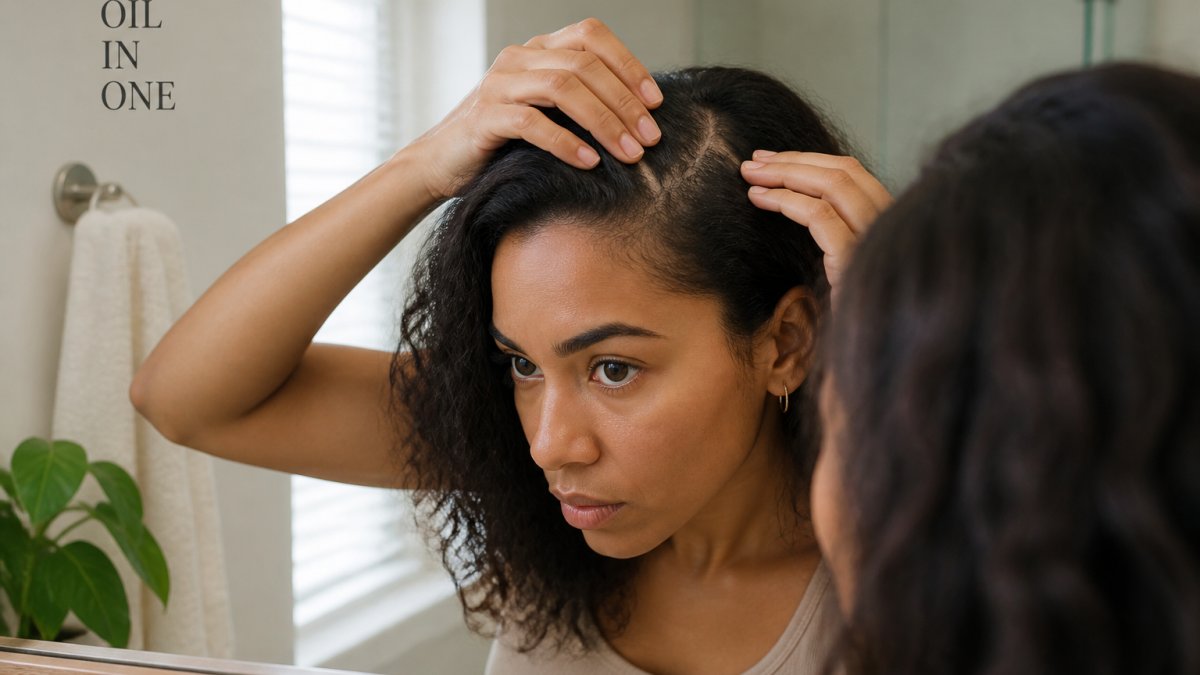
Signs of a Dry Scalp: Tightness, Itching, and Fine Flakes
Dry scalp symptoms are usually mild but persistent. Look for:
- A tight, stretched feeling after washing
- Itching that worsens in air conditioning or dry heat
- Small, powdery white flakes on shoulders and collarbone
If your scalp feels tight within an hour of washing, that is your clearest signal.
Dry Scalp vs Dandruff: Why the Difference Changes What You Buy
Dry scalp is moisture loss. Dandruff is a flaking condition linked to oil and yeast activity, with larger, greasier, yellowish flakes.
The buying decision flips entirely. Dry scalp needs hydrating, soothing formulas. Dandruff needs anti-dandruff actives. Using one for the other backfires.
If flakes are yellow, oily and cling to the scalp, see a dermatologist before buying anything. For genuine dryness, our guide to soothing an itchy scalp naturally walks through the steps.
What Causes Dryness and Irritation in This Climate
Heat, hard water and constant air conditioning drain moisture from the scalp faster than most people realise. This climate is unusually tough on scalps.
Here is what we see driving dryness most often:
- Hard water: mineral buildup coats the scalp and blocks moisture
- Intense heat: sweat, then rapid evaporation, leaves skin dehydrated
- Air conditioning: low humidity pulls water from skin all day
A common mistake is washing more often to fix flaking. That usually makes it worse.
Ingredients for Dry Scalp: What to Look For and What to Avoid
Ingredient lists are easy to copy and hard to use. The useful question is not "does it contain aloe?" but "what job does this ingredient do, at what strength, and will it suit my scalp?" Dry-scalp formulas generally need to do three things: attract water, hold it in, and calm irritation without stripping. Read labels against those three jobs.
Humectants: Pull Water Into the Scalp
Humectants bind water from the air and from deeper skin layers. They are the first line of defence against tightness.
- Glycerin, the most common and best-studied humectant. Effective at low percentages (often 3-10% in leave-on and rinse-off products). Generally well tolerated, but in very low humidity it can draw moisture from the skin rather than the air, so pair it with an occlusive.
- Hyaluronic acid and sodium hyaluronate, hold large amounts of water relative to their weight. Lightweight and non-greasy; useful in serums and leave-ins rather than shampoos, which rinse them away.
- Panthenol (provitamin B5), humectant and skin-conditioning agent; common in both shampoos and leave-ins at 1-5%. A reasonable choice for sensitive scalps.
Occlusives and Emollients: Stop Moisture Escaping
Humectants without an occlusive can leave the scalp feeling hydrated then tight again within hours. Occlusives form a light film that slows water loss.
- Plant oils, jojoba, argan, squalane and similar light oils seal moisture without the heaviness of mineral oil. Jojoba is structurally close to scalp sebum and is a common choice for oily-but-dry scalps.
- Shea butter and fatty alcohols (cetearyl, cetyl), richer occlusives better suited to dry, coarse or coily hair than to fine hair, where they can weigh roots down.
- Squalane, lightweight, non-comedogenic, and a good option for fine hair or scalps that dislike heavy oils.
Soothing Agents: Calm the Itch
- Colloidal oatmeal, recognised for soothing and barrier support; common in scalp masks and gentle shampoos (pubmed.ncbi.nlm.nih.gov).
- Aloe vera, cooling and lightly hydrating; useful in after-sun or post-wash scalp products.
- Bisabolol and allantoin, anti-irritant agents often added at low percentages to sensitive-scalp formulas.
What to Avoid, and Why
- Strong sulfates (SLS, SLES), effective cleansers but can strip lipids from an already dry scalp, especially at high concentrations and with frequent washing. Mild surfactants (cocamyl glucoside, sodium cocoyl isethionate) clean adequately with less disruption.
- Drying alcohols (denatured alcohol, SD alcohol), appear high on the list in some scalp toners; they evaporate quickly and can leave the scalp tighter.
- Heavy fragrance and essential oils, a common trigger for contact irritation. If you are sensitive, choose fragrance-free or low-fragrance formulas and patch test first.
For a deeper look at calming botanicals, see our breakdown of the best oils for an itchy scalp. The American Academy of Dermatology's guidance on dry skin care also stresses gentle cleansing over aggressive scrubbing.
How to Pick the Best Shampoo for Dry Scalp
The best shampoo for dry scalp is a gentle, sulfate-free formula that cleans without stripping, paired with moisturising ingredients. That single rule filters out most of the shelf.
Use this checklist before buying:
- Sulfate-free or very mild surfactants
- Contains a humectant such as glycerin
- Soothing botanicals like aloe or oat
Skip anything labelled clarifying or deep-clean for daily use. Those belong in a rotation, not a routine.
How Often to Wash Hair With Dry Scalp
Washing two to three times a week suits most dry scalps. More frequent washing strips moisture faster than the scalp can replace it.
Adjust by hair type:
| Hair Type | Wash Frequency | Why |
|---|---|---|
| Fine, straight | 2-3 times weekly | Oils travel fast, but scalp dries quickly |
| Thick or curly | 1-2 times weekly | Less stripping, more moisture retention |
| Oily roots, dry ends | 2-3 times weekly | Focus shampoo on scalp only |
| Sensitive or eczema-prone | 1-2 times weekly | Fewer washes, gentler formulas |
Rinse with lukewarm water, never hot. Hot water accelerates moisture loss.
Building a Complete Routine: Conditioner, Leave-In, and Scalp Treatment
Most guides stop at shampoo. But the keyword is about choosing hair care products, plural, and a dry scalp routine only works when each product category does a distinct job. Treat this as a selection framework: for each category, know what it should do, what to look for, and how to apply it.
1. Shampoo, Cleanse Without Stripping
Job: remove oil, sweat and buildup while leaving the scalp barrier intact.
Look for: mild surfactants (cocamyl glucoside, sodium cocoyl isethionate), a humectant such as glycerin, soothing agents like aloe or oat, and low or no fragrance.
Application: focus shampoo on the scalp, not the lengths. Massage with fingertips for 30-60 seconds, then rinse with lukewarm water. One wash is usually enough; a second wash is only needed if the scalp is genuinely oily or has product buildup.
2. Conditioner, Restore the Hair, Protect the Scalp
Job: smooth the hair cuticle and reduce friction, which matters because dry, rough hair snaps more easily.
Look for: fatty alcohols (cetearyl, cetyl), plant oils, and panthenol. For fine hair, choose a lightweight formula and keep it off the roots. You can browse the nourishing conditioner that completes this routine.
Application: mid-lengths to ends only. Rinse thoroughly, residue on the scalp can cause itching that mimics dryness.
3. Scalp Treatment, The Step Most Routines Skip
Job: deliver sustained moisture and soothing agents directly to the scalp between washes.
Options and who they suit:
- Light oils (jojoba, squalane, argan), best for most dry scalps; apply to damp, not dripping, hair so the oil absorbs rather than sits on top.
- Scalp serums with hyaluronic acid or niacinamide, good for fine hair or scalps that dislike oil.
- Soothing masks with colloidal oatmeal, useful for reactive or itchy scalps; use weekly rather than daily.
Application: part the hair in sections, apply a few drops along each part, and massage for 3-5 minutes. A bamboo scalp massager helps distribute product evenly and loosen buildup. Leave on for at least 30 minutes, or overnight if the formula allows, then wash out.

4. Leave-In and Protection, Seal in Moisture
Job: keep ends hydrated and protect hair from heat and friction between washes.
Look for: lightweight leave-in conditioners, heat protectants, and light oils. Avoid heavy butters on fine hair, where they can flatten roots.
Application: on damp ends after washing. A small amount goes a long way, start with a pea-sized quantity and add more only if needed.
How to Tell It's Working
Give a new routine four to six weeks before judging it. Signs of progress:
- Less tightness within an hour of washing
- Fewer flakes on shoulders and collarbone
- Reduced itching, especially in air conditioning
If flaking, redness or itching worsens after two to three weeks, stop the newest product first, it is the most likely culprit, and review the ingredient list for fragrance, drying alcohols or strong sulfates.
Patch Test New Products Before You Commit
Patch testing prevents reactions, especially on a sensitive scalp. It takes 48 hours and costs nothing.
How to do it:
- Apply a small amount behind the ear or on the inner forearm
- Leave it 24 hours, then check for redness or itching
- If clear, test a coin-sized amount on the scalp edge
Introduce one new product at a time. If a reaction appears, stop and note the ingredient. The NHS guidance on allergies and patch testing explains what reactions to watch for.
Watch out: testing three new products at once tells you nothing about which one caused the problem.
Shop the Oil In One Scalp-First Routine
Healthy hair starts at the scalp, and that is the principle behind everything we make at Oil In One.
What our customers tell us matters most:
"I barely get an itchy scalp.", Hajer A., Hair Routine
"This oil is not greasy and it absorbs very well.", Noor H., Growth Oil
Our formulas are built for this climate: non-greasy, easy to wash out, and made to calm itchy, flaky scalps while sealing in moisture. Trusted by 500+ customers.
Frequently Asked Questions
How can I tell if my scalp is dry or oily?
Check your scalp a few hours after washing. A dry scalp feels tight and itchy, with fine white flakes that sit on the surface. An oily scalp looks shiny near the roots and flakes are larger and yellowish. If you are unsure, blot your scalp with a tissue: no residue points to dryness, while visible oil points to an oily scalp.
What ingredients should I avoid if my scalp is dry or sensitive?
Skip strong sulfates, high concentrations of alcohol, and heavy synthetic fragrance, which strip moisture and can trigger irritation. Some people also react to methylisothiazolinone preservatives. Read labels and choose short ingredient lists with soothing options like aloe and oat. Always patch test a new product on a small area for 48 hours before full use.
Should I use conditioner if I have a dry scalp?
Yes, but apply it from mid-length to ends only. Conditioner softens strands and reduces friction, which helps prevent breakage. Keep it off the scalp so it does not weigh down roots or trap residue. If your scalp feels tight, a light leave-in or scalp oil used before washing can add moisture without buildup.
When should I see a dermatologist about a dry, itchy scalp?
Book a dermatologist if itching is severe, flakes are thick or yellow, or you notice redness, swelling, or patches that spread. These can signal seborrheic dermatitis or psoriasis rather than simple dryness. Persistent symptoms after four weeks of gentle care also warrant a professional check, especially if hair loss is increasing.
Your scalp does not need ten products. It needs the right four, used consistently, chosen for dryness rather than dandruff. Start with a gentle sulfate-free cleanse, add a nourishing conditioner, treat the scalp with a light botanical oil, and patch test anything new. Oil In One builds exactly this kind of scalp-first routine, with transparent ingredients and formulas made for the heat and hard water here. Get started with Oil In One and give your scalp the moisture balance it has been missing.
