

How to Use a Hair Mask for Dry Hair, Step by Step
Editorial TeamLast Updated: November 3, 2026
Quick Summary
To use a hair mask for dry hair, shampoo first, then apply the mask from mid-lengths to the ends, avoiding the roots. Comb it through, cover your hair, and leave it on for 10 to 30 minutes before rinsing with lukewarm water.
- Apply the hair mask after shampooing, when hair is clean and most open to absorbing moisture.
- Start applying from the middle of the hair down to the ends, where dryness is worst.
- Leave most masks on for 10 to 30 minutes, and use a timer so you do not forget.
- Rinse with lukewarm water, since hot water can dry hair out again.
- Use a mask once a week to start, and give any new routine four to six weeks to judge.
Table of Contents
- Why Dry Hair Needs a Mask and What It Does
- Moisture or Protein: How to Tell What Your Hair Needs
- Choosing an Ingredient-Led Homemade Hair Mask for Dry Hair
- Step-by-Step: How to Apply a Hair Mask for Dry Hair
- How Long to Leave a Hair Mask On
- Hair Mask Before or After Shampoo, and How Often to Use It
- Signs You Are Using a Hair Mask Too Often
- Building Your Dry Hair Routine Around Your Mask
- Frequently Asked Questions
Why Dry Hair Needs a Mask and What It Does
A hair mask is a rich, concentrated conditioner you leave on for longer than your usual rinse. Dry hair needs it because the strands have lost the moisture and natural oils that keep them soft, flexible and smooth. A mask works on the lengths and ends, which is where dryness shows most.
Dry hair usually shows up in a few clear ways:
- Ends that feel rough, look frayed or split
- Strands that tangle easily when you brush
- Frizz that appears in dry or humid weather
- Hair that feels brittle and breaks more often
A good mask helps in three ways. It adds moisture, it softens the cuticle so strands feel smoother, and it seals that moisture in so it lasts. Many people notice a difference after using one, especially after washing in hard water.
Moisture or Protein: How to Tell What Your Hair Needs
Before you pick a mask, figure out what your hair is actually asking for. Dry hair usually needs moisture, but hair that feels limp, stretchy or mushy when wet may need protein instead. Using the wrong one can make the problem worse.
Here is a simple way to tell:
- Needs moisture: Hair feels rough, dull or straw-like, and tangles easily.
- Needs protein: Hair stretches a lot when wet, feels gummy, or breaks even when you handle it gently.
- Needs both: Hair is dry but also weak. Alternate a moisture mask with a protein treatment.
Try a quick test. Wet a single strand and gently stretch it. If it springs back, your hair likely has enough protein. If it stretches far and does not return, it may need protein. Start with a moisture-focused mask and watch how your hair responds over two or three uses.
Choosing an Ingredient-Led Homemade Hair Mask for Dry Hair
Homemade masks can work well for dry hair, as long as you choose ingredients for a clear purpose. Each one should have a job. The table below explains what each ingredient actually does, so you can build a mask around your hair's specific problem rather than copying a recipe.
| Ingredient | What it does | Best for | Watch out for |
|---|---|---|---|
| Olive oil | Coats the strand and slows water loss; high in oleic acid | Coarse, very dry hair | Can feel heavy on fine hair; hard to rinse |
| Argan oil | Light slip and shine; absorbs faster than olive oil | Fine to medium hair, frizz | Pricier; check for dilution |
| Honey | Humectant, draws water from the air into the strand | Dull, dehydrated hair | Sticky; can lighten hair slightly over time |
| Avocado | Fatty acids and creaminess that smooth the cuticle | Brittle, rough ends | Goes off quickly once mashed |
| Banana | Softens and adds body | Dry, thick hair | Chunks rinse out poorly unless blended smooth |
| Aloe vera | Light, cooling hydration layer | Sensitive scalp, fine hair | Can feel drying if left on too long |
| Yogurt | Lactic acid gently smooths the cuticle | Dull, buildup-prone hair | Not for very sensitive scalps |
Keep it simple. Mixing six or seven ingredients rarely helps and can make rinsing harder. A workable formula is one oil, one humectant and one creamy base, for example, a tablespoon of olive oil, a teaspoon of honey and two tablespoons of mashed avocado for mid-length hair. Adjust the amount to your hair's length and density.
A common pattern is that readers react to one ingredient and not another. Test any new ingredient on a small patch of skin first, especially if you have eczema-prone or sensitive skin. Stop using it if you notice itching, redness or flaking. Essential oils, citrus juice and cinnamon are frequent irritants and are best avoided on the scalp.
If you would rather not mix anything, a ready-made product is an option. Read the label in this order: the first five ingredients (these make up most of the formula), then the preservatives, then the fragrance. Water or aloe vera near the top usually signals a lighter, moisture-focused mask; oils and butters near the top signal a heavier, sealing mask. Fragrance and essential oils high on the list are worth noting if your scalp is reactive.
Step-by-Step: How to Apply a Hair Mask for Dry Hair
Applying a mask correctly matters as much as the mask itself. Follow these steps for the best results.
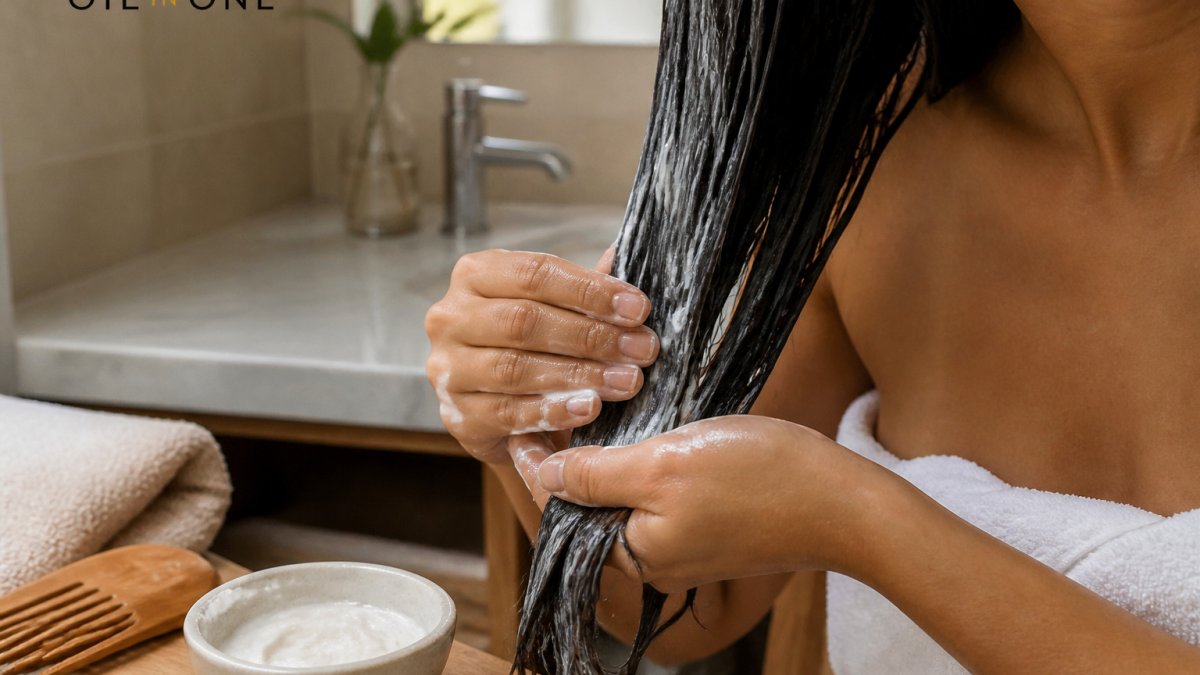
- Wash your hair first. Use a gentle shampoo to clear product buildup. Pat your hair dry so it is damp, not dripping.
- Section your hair. Split it into 4 or 6 sections. This helps you cover every strand evenly.
- Start at the mid-lengths. Apply the mask from the middle of the hair down to the ends, where dryness is worst.
- Focus on the ends. Use a little extra mask on the tips, but avoid the scalp unless your product is made for it.
- Comb through. Use a wide-tooth comb to spread the mask evenly and detangle gently.
- Cover and wait. Put on a shower cap or wrap your hair in a towel to keep warmth in.
- Rinse with lukewarm water. Hot water can dry hair out again. Rinse until the hair feels smooth, not slippery.
Watch out: Do not apply a heavy mask to your roots. It can weigh hair down and make an itchy or flaky scalp feel worse.
How Long to Leave a Hair Mask On
Most masks work best when left on for 10 to 30 minutes. Read the product label first, since some formulas need less time and some need more. For a homemade mask, 15 to 20 minutes is a good starting point.
Leaving a mask on longer does not always mean better results. After about 30 minutes, many masks stop adding benefit, and some can leave hair heavy. If your hair is very dry or coarse, you can leave the mask on a little longer, but keep an eye on how it feels.
Use a timer so you do not forget. A shower cap or towel keeps the mask warm, which helps the ingredients absorb.
Hair Mask Before or After Shampoo, and How Often to Use It
Where a mask fits in your routine depends on your hair. In most cases, apply it after shampooing. This is when hair is clean and most open to absorbing moisture. Shampoo first, then mask, then rinse.
Some people with very dry hair like to apply a light oil before shampooing, which can protect strands from stripping. If you do this, use a gentle shampoo and follow with your mask. A pre-shampoo oil is not a substitute for a mask, it is a buffer, not a treatment.
For frequency, use the table below as a starting point and adjust based on how your hair responds.
| Hair condition | Starting frequency | Adjust up if | Adjust down if |
|---|---|---|---|
| Mildly dry, otherwise healthy | Once a week | Ends still rough after 3-4 weeks | Hair feels limp mid-week |
| Very dry or coarse | Twice a week | Hair still feels straw-like | Roots look greasy |
| Color-treated or bleached | Once a week, plus a protein mask every 2-3 weeks | Breakage continues | Hair feels gummy when wet |
| Fine hair with dry ends | Once a week, mid-lengths to ends only | Ends still fray | Hair loses volume |
| Oily roots, dry ends | Once a week, ends only | Ends still split | Scalp feels itchier |
Give any new routine about four to six weeks before you judge it. Dry hair takes time to rebuild, and steady use gives you a clearer picture of what works. A realistic expectation is softer ends and easier detangling within two to three washes, with visible shine and less frizz after about a month of consistent use. If nothing changes after six weeks, the mask is probably the wrong type for your hair, switch from a sealing oil-based mask to a humectant-led one, or the reverse.
Bear in mind that hard water can leave a film on hair, so some people find a mask helps more when they also use a gentle clarifying shampoo every two to three weeks. Clarifying too often, however, strips the moisture you are trying to add.
Watch out: more is not always better. Using a mask too often can leave hair feeling limp, heavy or greasy soon after washing, flat and lacking bounce, gummy or stretchy when wet, or can make the scalp itchy and flaky. If you notice any of these, cut back to once every two weeks for a while, then try a lighter mask. If problems continue, ask a dermatologist or hair professional, especially if you are losing more hair than usual or have a persistent scalp condition.
Signs You Are Using a Hair Mask Too Often
More is not always better. Using a mask too often can leave hair feeling different from what you want. Watch for these signs:
- Hair feels limp, heavy or greasy soon after washing
- Strands look flat and lack natural bounce
- Hair feels gummy or stretchy when wet
- Your scalp becomes itchy or flaky
If you notice any of these, cut back to once every two weeks for a while. Then try a lighter mask. If problems continue, ask a dermatologist or hair professional, especially if you are losing more hair than usual or have a persistent scalp condition.
Building Your Dry Hair Routine Around Your Mask
A mask works best as part of a simple routine, not a one-off fix. Here is a basic weekly plan you can adjust to your hair:
- Daily or every other day: Use a gentle shampoo and a light conditioner on the lengths.
- Once a week: Use your hair mask after shampooing.
- Every few weeks: Check your hair. If it feels weighed down, skip a week. If it still feels dry, keep your routine.
Keep your routine simple. You do not need many products. Pick a gentle shampoo, a conditioner that suits your hair, and one good mask.
Give any new routine about four to six weeks before you judge it. Dry hair takes time to rebuild, and steady use gives you a clearer picture of what works.
Frequently Asked Questions
How often should you use a hair mask on dry hair?
For most dry hair, a deep conditioning hair mask once or twice a week is a sensible starting point. Hair that is very dry, coloured or damaged may tolerate more frequent use, while fine hair may do better with less. Watch how your hair feels after each use. If it starts to look limp, feel gummy or tangle more, cut back to once every two weeks and let your hair tell you when it needs more.
How long should you leave a hair mask on dry hair?
Most hair masks work well when left on for about 10 to 30 minutes, though the product label gives the most reliable guidance for a specific formula. Leaving a mask on longer does not always mean better results, and some formulas can build up on the hair. Cover your hair with a shower cap or towel to keep warmth in, which helps the ingredients settle into the strands.
Should you apply a hair mask to wet or dry hair?
Apply a hair mask to clean, damp hair rather than soaking wet or completely dry hair. Damp hair takes up the product evenly and lets the mask spread through the lengths without dripping. Start at the mid-lengths and ends, where dryness is usually greatest, and keep the mask away from the scalp unless the product is designed for it. Rinse with lukewarm water once the recommended time has passed.
Should you use conditioner after a hair mask?
In most cases you do not need a conditioner after a hair mask, because the mask already delivers conditioning and moisture. Adding a conditioner on top can leave dry hair feeling heavy or coated. If your hair still feels tangled after rinsing the mask, a light leave-in product on the lengths is usually a better choice than a full rinse-out conditioner.
