

Nourishing Conditioner for Weak Hair: A Practical Routine
Editorial TeamQuick Summary
A nourishing conditioner for weak hair works by protecting the strand rather than just smoothing it. Choose a moisture-led formula with light botanical oils, apply it from the ends upward, and keep handling gentle through washing and drying.
- Weak hair needs moisture and strand protection, not just surface softness.
- Use a pea-sized amount for shoulder-length hair and keep it off the roots.
- Leave conditioner on for two to three minutes, then rinse with cool water.
- Wash two to three times a week and blot hair instead of rubbing it.
- Air-dry with loose braids or foam rollers and sleep on a satin or silk pillowcase.
Table of Contents
- Why Weak Hair Needs a Different Kind of Conditioner
- The Best Conditioner for Weak Hair: Ingredients That Matter
- How to Condition Fine Weak Hair Without Weighing It Down
- Conditioner for Hair Breakage: Application Technique
- A Simple Hair Care Routine for Weak Hair
- Common Mistakes That Undo Conditioning
- Start Your Routine With the Right Product
- Frequently Asked Questions
Why Weak Hair Needs a Different Kind of Conditioner
Last Updated: November 11, 2026
Weak hair breaks easily, and in the UAE the usual culprits are hard water, dry air and strong sun. Our guide on hair shedding from hard water explains the causes behind the breakage and what to do about them. A good nourishing conditioner for weak hair works differently from a standard one, because its job is to protect the strand, not just smooth it.
Most conditioners coat the surface of the hair and leave it feeling soft. That feels good for a day, but it does little for a strand that is thin, dry or fragile at the root. Weak hair needs ingredients that moisturize and help the strand hold together through washing and brushing.
Here is the practical difference. A standard conditioner is built to make hair feel smooth on the day you use it. A nourishing conditioner for weak hair is built to reduce breakage over several weeks of use.
- Standard conditioners focus on slip and softness
- Nourishing options focus on moisture and strand protection
- Weak hair needs both, but it needs the second one more
The Best Conditioner for Weak Hair: Ingredients That Matter
Look past the front label and read the ingredient list. If your scalp is dry or sensitive, how to choose hair care products for dry scalp walks through what to look for alongside weak-hair formulas. The first few ingredients tell you the most, because they make up the largest share of the formula.
Protein Versus Moisture: Reading the Label
Protein conditioners can help hair that is stretched or overprocessed. Too much protein, though, can make hair stiff and brittle. Moisture-based conditioners add softness and flexibility without that stiffness.
- If your hair snaps like dry string, it may need moisture first
- If your hair feels limp and mushy, a small amount of protein may help
- Most people with weak hair do better with a moisture-led formula
Why Light Botanical Oils Work for Hot, Hard-Water Conditions
Heavy butters and thick silicones can coat weak hair and weigh it down. Lighter botanical oils absorb better and rinse out more easily, which suits humid, hard-water conditions well.
Oil In One's formula uses a blend of botanical oils chosen for clear purposes, and every ingredient is listed in plain language.
How to Condition Fine Weak Hair Without Weighing It Down
Fine hair needs care that adds strength without flattening the hair. Too much product is the most common mistake.
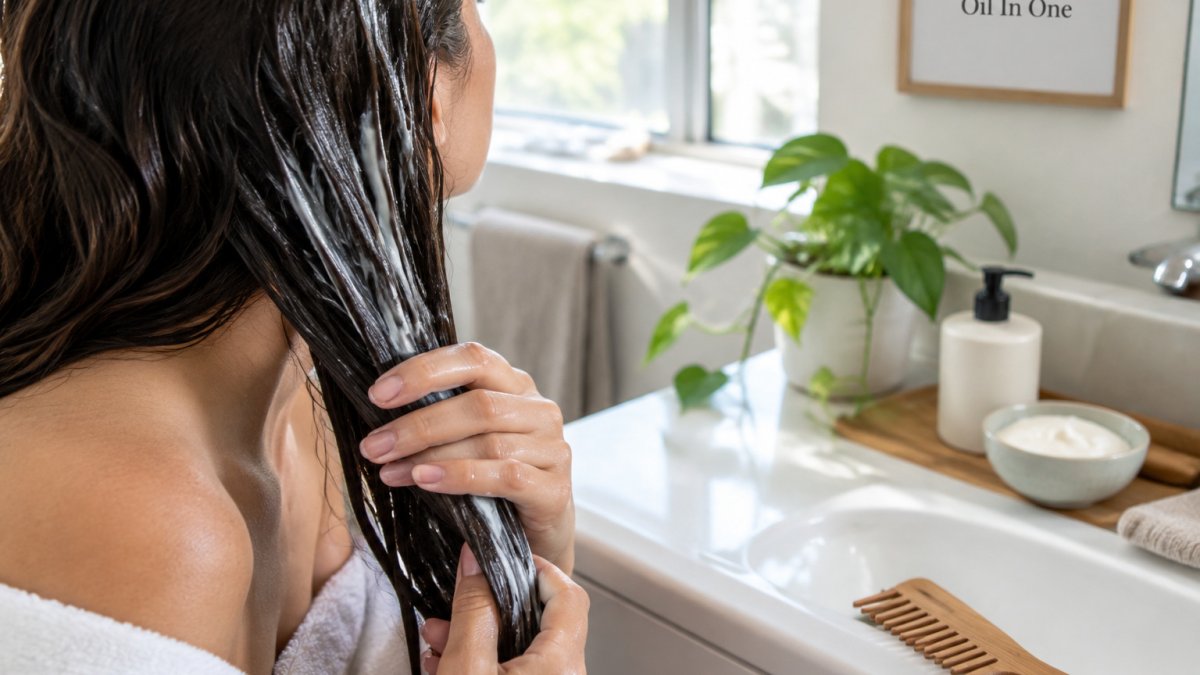
Follow these steps for fine, weak hair:
- Start with a pea-sized amount for shoulder-length hair
- Work it through the mid-lengths and ends, not the roots
- Leave it on for two to three minutes
- Rinse with cool water to help close the cuticle
- Blot gently with a towel instead of rubbing
Watch out: Applying conditioner directly to the scalp can leave fine hair limp and greasy at the root.
Conditioner for Hair Breakage: Application Technique
Breakage usually happens at the point of most friction, which is the ends and the mid-lengths. For a dedicated guide, see how to prevent hair breakage after washing. How you apply conditioner matters as much as which one you choose.
Work in sections, starting from the ends and moving up. Use your fingertips or a wide-tooth comb, and never yank through knots. Detangle while the conditioner is in, since that is when the hair is most slippery and least likely to snap.
Heat adds stress to weak hair, so pat dry and let it air-dry where you can. Our routine works best when you keep handling gentle from the first wash to the last brush.
A Simple Hair Care Routine for Weak Hair
A routine for weak hair works best when every step reduces stress on the strand. The schedule below is built around one goal: keep heat and friction low from the moment you step into the shower to the moment you go to sleep.
Step 1: Wash two to three times a week. Washing more often strips the natural oils that weak hair relies on. Use a gentle, sulfate-free shampoo and concentrate it on the scalp, letting the suds rinse down the lengths rather than scrubbing the ends together.
Step 2: Condition the mid-lengths and ends. Apply conditioner from the ends upward, then detangle with a wide-tooth comb while the product is still in. Hair is most elastic and least likely to snap when it is wet and slippery, so this is the safest moment to remove knots.
Step 3: Blot, do not rub. Wrap the hair in a cotton t-shirt or a microfiber towel and press gently. Rough towel-drying roughens the cuticle and is one of the most common sources of breakage in weak hair.
Step 4: Air-dry without heat. Let the hair dry in a loose style. Two heatless methods suit weak hair well:
- Loose braids: Braid damp hair in two or three sections, leaving the braids loose so tension stays low, and let them dry overnight.
- Foam rollers or flexi-rods: Wrap sections around soft rollers with minimal tension, then leave them until fully dry.
In humid conditions common across the UAE, allow extra time, since hair can take noticeably longer to dry completely. Avoid sleeping on wet hair, which increases friction and can cause tangling.
Step 5: Treat once a week. Apply a light botanical oil to the scalp, massaging gently with the fingertips for a few minutes. To learn how long to leave oil in your hair, see our best-practice tips. Rinse thoroughly so residue does not weigh the roots down.
Step 6: Protect the hair at night. Tie hair loosely in a low ponytail or braid, and use a satin or silk pillowcase to reduce friction against the scalp and strands while you sleep.
Watch out: Heatless drying takes patience. If you rush it with a hairdryer on low, you lose the benefit of the routine, so give the hair the full drying time instead.
The routine below lays out each step with its timing so you can follow it week to week.
| Step | What to do | Time or frequency |
|---|---|---|
| Wash | Use gentle, sulfate-free shampoo on the scalp | Two to three times a week |
| Condition | Apply from ends upward, detangle with a wide-tooth comb | Every wash |
| Dry | Blot with a cotton t-shirt or microfiber towel | Every wash |
| Air-dry | Use loose braids or foam rollers, no heat | Until fully dry |
| Oil treatment | Light botanical oil massaged into the scalp, then rinsed | Once a week |
| Night care | Loose low ponytail or braid, satin or silk pillowcase | Every night |
Common Mistakes That Undo Conditioning
Most conditioning failures come from a handful of habits that look harmless. Each one works against the strand in a specific way, and knowing the mechanism makes the fix easier to stick to.
Using too much product. Heavy amounts coat the hair without penetrating it, leaving fine or weak strands limp at the root and residue that builds up between washes. Start with a small amount and add more only to the ends if needed.
Skipping the rinse, or rinsing too briefly. Conditioner left in the hair can make it feel greasy and dull. Rinse until the hair no longer feels slippery, and finish with cool water, which helps the cuticle lie flatter and reflect more light.
Rubbing the hair with a towel. Friction lifts the cuticle, and lifted cuticles are more prone to snapping. Press and squeeze gently instead.
Brushing wet hair roughly. Wet hair stretches further than dry hair before it breaks. Start detangling from the ends, work upward, and use a wide-tooth comb rather than a fine-toothed brush.
Applying conditioner only to the scalp. The scalp produces its own oils, and conditioner on the roots tends to weigh them down. Keep it focused on the lengths, where weak hair is most fragile.
Switching products every week. Changes in hair condition often take several weeks to appear, so constant switching makes it impossible to tell what is working. Commit to one routine for four to six weeks before judging it.
Expecting fast results. Scalp care takes weeks, not days, so give a routine time before judging it. Judge progress by how much hair you lose in the shower and on your brush across several weeks, not by how it looks on a single day.
Start Your Routine With the Right Product
A nourishing conditioner for weak hair is most useful when it fits into a routine you can stick with. At Oil In One, our products are built from plain-language ingredients chosen for clear purposes, so you can see exactly what goes on your hair and why. Pricing depends on the size and the offer, so check our website for current prices and product details before you decide.
BUTTON: Shop Oil In One CARD_TITLE: Stronger hair starts at the scalp CARD_TEXT: Simple, transparent botanical care built for hard-water and hot UAE conditions.
Frequently Asked Questions
What is the best conditioner for weak hair?
The best conditioner for weak hair is one that balances strengthening and moisture without heavy residue. Look for light, plant-based oils and conditioning agents that rinse out easily, and check the ingredient list for plain-language labelling so you know what each component does. Oil In One's formulas use 100% natural botanicals in a light oil base, designed to nourish weakened roots and seal in moisture. Results depend on your hair type and how consistently you use it, so judge a product over several weeks rather than after one wash.
How often should you condition weak hair?
Most people with weak hair do well conditioning after every wash, since washing removes moisture and leaves strands more exposed. If your hair feels heavy or limp, condition only the lengths and ends and reduce frequency to two or three times a week. Apply a few drops of an oil-based conditioner to the mid-lengths and ends, leave it for a few minutes, then rinse thoroughly. Watching how your hair feels between washes is the most reliable guide.
Should you use conditioner on your scalp or just the lengths?
Conditioner is usually best applied to the mid-lengths and ends, where hair is oldest and most prone to breakage. Applying heavy conditioner directly to the scalp can leave roots feeling weighed down and can contribute to buildup. If you have a dry or itchy scalp, use a targeted scalp treatment instead and keep your conditioner away from the roots. Rinse well so no residue remains near the scalp.
What is the difference between a strengthening conditioner and a moisturizing conditioner?
A strengthening conditioner typically contains proteins or ingredients intended to reinforce the hair shaft, which can help with breakage when hair is over-processed or stretched. A moisturizing conditioner focuses on hydration with oils, butters or humectants to soften and add flexibility. Weak hair often needs both, so many people alternate between them or choose a product that combines them. Pay attention to how your hair responds: stiffness and snapping often point to too much protein, while limpness and frizz suggest more moisture is needed.
