

7 Dry Scalp Treatments for Men That Actually Work
Editorial TeamLast Updated: November 21, 2026
Quick Summary
A dry scalp treatment for men starts with washing every two to three days in lukewarm water using a gentle, sulfate-light shampoo, then applying a few drops of oil at the root three times a week for 15 to 20 minutes before rinsing. Give the routine a full 15 weeks before judging results.
- Wash every two to three days, not daily, and turn the water down to lukewarm.
- Apply oil at the root, massage two to three minutes, and leave it 15 to 20 minutes.
- Dry scalp flakes are small and white; dandruff flakes are larger, yellowish and greasy.
- Patch test new oils on your inner arm for 24 hours before use.
- See a dermatologist if thick plaques, bleeding, spreading redness or rapid hair loss appear.
Table of Contents
- Why Men Get Dry Scalps in Heat, Hard Water and Air Conditioning
- Dry Scalp vs Dandruff: How to Tell Which One You Have
- How Often to Wash Hair With Dry Scalp
- Choosing the Best Shampoo for Dry Scalp Men Can Use Daily
- A Dry Scalp Treatment at Home in Five Steps
- Which Oils and Ingredients Actually Soothe a Dry Scalp
- Fades, Hats and Styling Products: What Men's Grooming Does to the Scalp
- How Long Treatment Takes and When to See a Dermatologist
- Build Your Scalp Routine With Oil In One
- Frequently Asked Questions
Why Men Get Dry Scalps in Heat, Hard Water and Air Conditioning
A dry scalp is skin under pressure, and here it takes a beating from three directions at once: intense heat, mineral-heavy water, and air conditioning that pulls moisture out of the air for hours a day.
Hard water is the one most men overlook. The minerals in it leave a film on the scalp that disrupts the natural barrier, so moisture escapes and irritation builds. Add a hot shower, and you strip the oils that were protecting the skin in the first place.
Itching and flaking often start after a move, a new apartment, or a change in wash routine. The fix is rarely a stronger product. It is a gentler, more consistent routine built around what your scalp is actually dealing with.
The signs that point to dryness rather than something else
Dryness has a signature. Look for tightness after washing, fine white flakes that brush off easily, and itching that worsens in air conditioning or after a hot shower. Redness is usually mild and patchy.
If instead you see greasy yellow scales, thick plaques, or flakes stuck to the scalp, that points somewhere else entirely, and we cover that next.
Dry Scalp vs Dandruff: How to Tell Which One You Have
Dry scalp is a moisture problem. Dandruff is a shedding and yeast-balance problem. They look similar in a mirror and behave nothing alike, and choosing the wrong treatment is the fastest way to make either one worse.
Dry scalp flakes are small, white, and dry. The scalp feels tight after washing, itches more in air conditioning or after a hot shower, and redness, when it appears, is mild and patchy. Dandruff flakes are larger, often yellowish, and cling to the scalp and hair. Dandruff usually comes with oiliness, and the scalp may feel greasy within a day of washing rather than tight.
Why does the distinction matter? Because the treatments pull in opposite directions. Moisturizing oils and gentler washing help dryness. Dandruff needs regular cleansing and, in persistent cases, an antifungal ingredient. Moisturize dandruff and you often make it worse, because the oil feeds the yeast balance problem rather than calming it.
If you are unsure, try the simple test: wash with a gentle shampoo, skip all oils for a week, and note whether flakes get better or worse. If they improve without added moisture, you are likely dealing with dandruff. If your scalp feels tighter and itchier, dryness is the better bet.
When it is neither: seborrheic dermatitis, psoriasis and contact irritation
Three other conditions mimic both, and each needs a different response. Seborrheic dermatitis causes greasy, yellowish scales with redness, often along the hairline, eyebrows, and the sides of the nose. It tends to flare with stress, cold weather, and heavy sweating, and it responds to antifungal and anti-inflammatory care rather than moisturizing alone. Psoriasis produces thick, silvery plaques that can extend past the hairline onto the forehead and neck; the plaques are well defined and may bleed if picked. Contact irritation shows up as itching and redness right where a product touches the skin, typically within hours or days of use, and it clears once the product is removed.
A practical way to sort them is to look at three things: flake color and texture, where the redness sits, and what makes it better or worse. White and powdery points to dryness. Yellow and greasy points to dandruff or seborrheic dermatitis. Silvery and thick points to psoriasis. Redness confined to the hairline where a product sits points to contact irritation.
These need a dermatologist's eye, not a shelf product. Our advice: if you see thick plaques, bleeding, spreading redness, or flakes that do not improve after several weeks of consistent care, stop self-treating and get it looked at. A dermatologist can confirm the diagnosis and prescribe a corticosteroid, a medicated ointment, or an antifungal when self-care is not enough. For natural steps to calm itching while you work out which one you have, see our guide on how to soothe an itchy scalp naturally.
How Often to Wash Hair With Dry Scalp
Wash every two to three days, not daily. That is the short answer for most men with a dry scalp. Daily washing with a strong shampoo strips the barrier faster than the scalp can rebuild it.
Adjust for your week. Heavy sweating, a dusty commute, or a swim means wash sooner. A quiet weekend indoors means you can stretch it. The goal is a scalp that feels clean without feeling tight.
Two habits matter more than frequency. First, turn the water down to lukewarm; hot water is one of the fastest ways to trigger scalp dryness. Second, rinse thoroughly, because leftover product buildup causes itching that looks exactly like dryness.
If you currently wash twice a day, cut to once and see what changes over two weeks. Most men notice less tightness before they notice less flaking.
Choosing the Best Shampoo for Dry Scalp Men Can Use Daily
A gentle, sulfate-light formula that cleans without stripping is a sensible choice for a dry scalp. Look for moisturizing ingredients rather than strong detergents, and treat "daily" as a claim to verify, not a label to trust.
Here is what we would check on the back of the bottle:
- Surfactants: gentler cleansing agents over harsh sulfates
- Humectants: glycerin draws water into the skin
- Soothing botanicals: aloe vera and tea tree oil in modest amounts
- No heavy fragrance load: fragrance is a common irritant
- A clear ingredient list: if you cannot read it, skip it
A common mistake is buying a medicated shampoo for what is actually dryness. Medicated formulas are built for dandruff and can be drying when used on a scalp that just needs moisture. For a deeper walkthrough on matching products to a dry scalp, read our guide on choosing hair care products for a dry scalp.
Watch out: if a shampoo leaves your scalp tight and squeaky-clean, it is doing too much. That feeling is stripped oil, not cleanliness.
A Dry Scalp Treatment at Home in Five Steps
A dry scalp treatment at home works best as a short, repeatable ritual, not an occasional deep clean. Fifteen minutes, three times a week, is enough.
- Part your hair and apply oil at the root. A few drops along each parting is plenty. More oil does not mean more benefit.
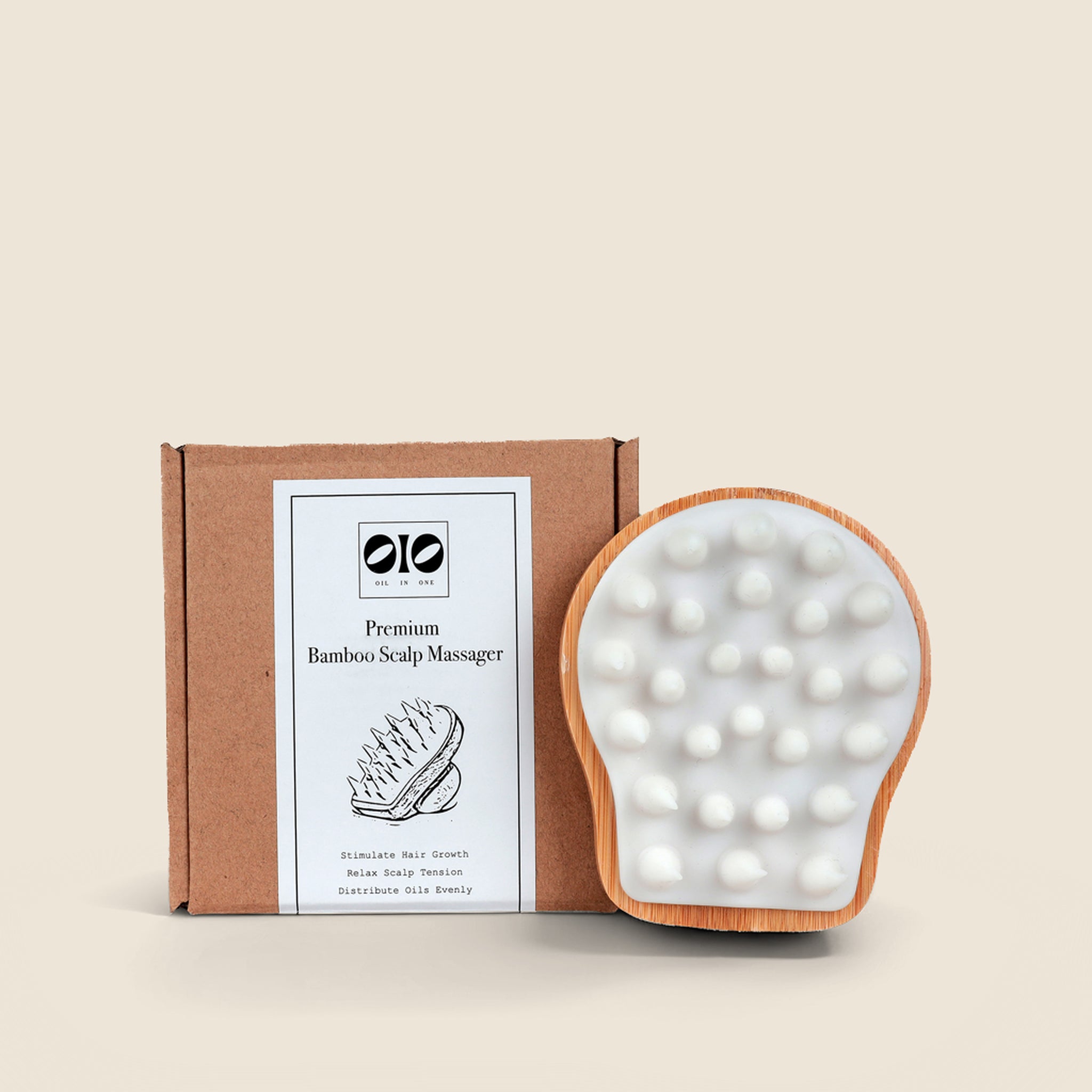
- Massage gently with fingertips, never nails. Two to three minutes in small circles. A bamboo scalp massager lets you keep light, even pressure without scratching.
- Leave it for 15 to 20 minutes. This is the working time, not a full afternoon.
- Shampoo as normal and rinse thoroughly. A light oil rinses out cleanly, so hair is not left heavy.
- Pat dry and skip heat styling. Let the scalp settle.
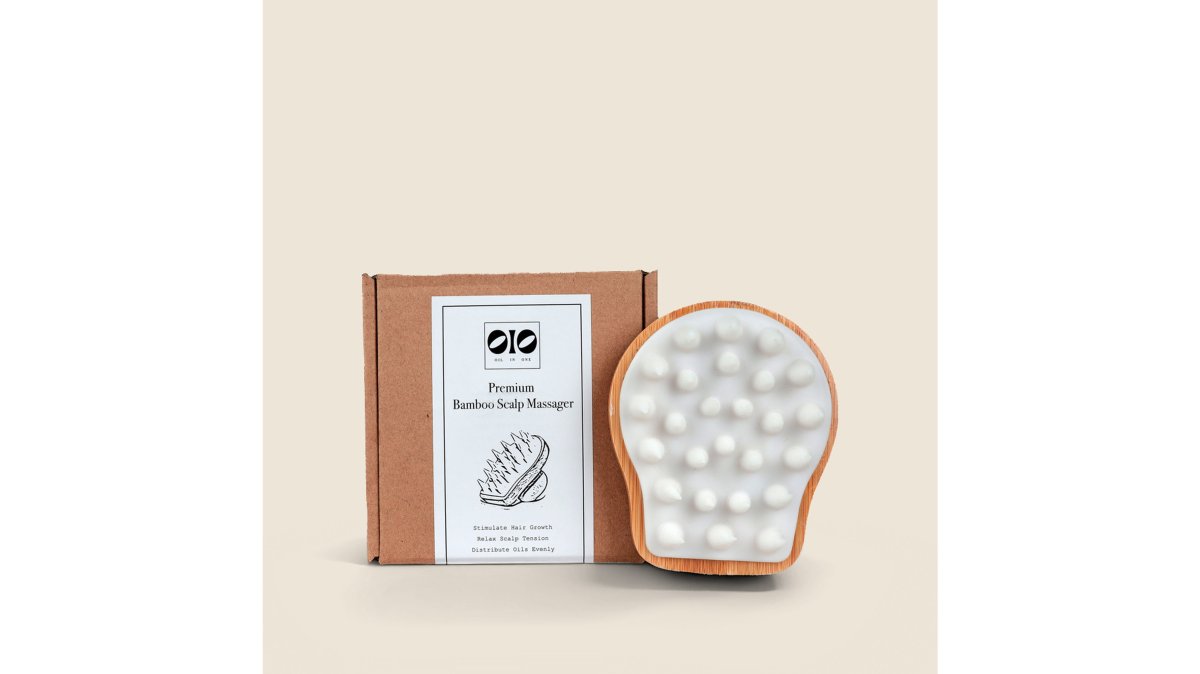
The most common mistake is over-applying. Excess oil sits on the scalp, traps buildup, and defeats the purpose. A few drops is the whole job.
Which Oils and Ingredients Actually Soothe a Dry Scalp
Oils such as jojoba, argan, and black seed are commonly chosen for dry scalps, and tea tree oil and aloe vera are often used for soothing support.
Deodorized oils are used heavily across the industry, and that processing can affect quality. At Oil In One, we blend 11 raw organic botanicals, including rosemary, bhringraj, black seed, pumpkin seed, jojoba, argan, avocado, and castor, and we list every one in plain language.
Two cautions. Patch test anything new on your inner arm for 24 hours, especially if your skin is sensitive. And do not layer five products at once; if something irritates, you will have no idea which one caused it. To read a botanical label properly, see our breakdown on reading a botanical hair oil label.
Fades, Hats and Styling Products: What Men's Grooming Does to the Scalp
Close fades and shaved sides expose scalp skin that is normally covered, and clipper blades can irritate it. Add a hat worn for hours in the heat, and you get trapped sweat and friction. Styling products pile on top, and residue builds up along the hairline.
The grooming routine that protects the scalp is simple:
- Clean your clippers and change blades so they cut rather than tug
- Moisturize exposed scalp after a fresh fade, the same way you would treat any dry skin
- Rotate hats and let them air out; a sweaty cap worn daily is a recipe for irritation
- Wash styling product out fully at the end of the day, not the next morning
- Go easy on heavy pomades and gels near the roots
None of this requires new products. It requires noticing that your scalp is skin, and treating the grooming steps that touch it with the same care as the rest of your routine.
How Long Treatment Takes and When to See a Dermatologist
Scalp care takes weeks, not days. Give a consistent routine a full 15 weeks before you judge it. That is roughly how long the skin needs to settle into a new balance, and it is why a single bottle is usually too short a trial to tell you anything useful.
A realistic timeline looks like this. In the first two weeks, most men notice less tightness after washing and a drop in itching, even if flakes are still visible. By weeks four to six, flakes on the collar should be fewer, and the scalp should feel calmer in air conditioning and after hot showers. By weeks eight to twelve, the barrier has had time to rebuild, and the routine should feel like it is holding rather than fighting. By week fifteen, you should be able to judge whether the routine is working or whether something else is going on.
Early signs you are on the right track: less tightness after washing, itching that fades, and fewer flakes on your collar. If those appear within the first month, keep going. If nothing changes by week six, the cause is probably not simple dryness, and it is worth revisiting the diagnostic section above before adding more products.
See a dermatologist if any of these apply:
- Symptoms persist or worsen after several weeks of consistent care
- You develop thick plaques, bleeding, or spreading redness
- Hair loss is patchy or rapid
- Over-the-counter options have failed more than once
- The scalp is painful, oozing, or hot to the touch
For a realistic timeline breakdown, read our article on how long dry scalp treatment takes to work. A dermatologist can also prescribe a corticosteroid or medicated ointment when self-care is not enough, and there is no shame in that. The key is not to keep buying new products hoping one will work; if the routine is right and the timeline has passed, the next step is a proper diagnosis.
Here is the timeline the article lays out for judging a dry scalp routine.
| Timeframe | What to expect |
|---|---|
| First two weeks | Less tightness after washing, less itching, flakes may remain |
| Weeks four to six | Fewer flakes on the collar, calmer in air conditioning |
| Weeks eight to twelve | Barrier has rebuilt, routine feels like it is holding |
| Week fifteen | Judge whether the routine is working |
| No change by week six | Cause probably not simple dryness |
Build Your Scalp Routine With Oil In One
The routine that works is the one you will actually repeat. That is the whole argument of this guide: not a cabinet full of products, but a short ritual done consistently, with ingredients you can read and understand.
At Oil In One, we built our all-in-one scalp oil around exactly that idea. It is a blend of 11 raw organic botanicals, including rosemary, bhringraj, black seed, and jojoba, chosen to calm itchy, flaky scalps and seal in moisture. It is light and non-greasy, so it rinses out easily and leaves hair without weight. Every ingredient is listed in plain language.
Our customers tell us what that consistency feels like. "I don't lose as much hair during my showers and brushing," says Maryam. "I barely get an itchy scalp," adds Hajer A. Noor H. puts it simply: "This oil is not greasy and it absorbs very well."
Our sizing is built around the 15-week window. One bottle is AED 120 for 50 ml, about five weeks. Two bottles are AED 216, saving 10%, and three bottles are AED 306, saving 15%. Apply a few drops along each parting before washing, three times a week, and store the bottle somewhere cool and dark.
If your scalp has been itchy and flaky for months, the missing piece is usually consistency, not another product. Oil In One makes a scalp-first routine simple: one light botanical oil, a clear ingredient list, and a wash-day ritual that takes minutes. Get started with Oil In One and give your scalp the full 15 weeks it needs to respond.
Frequently Asked Questions
What is the best treatment for dry scalp in men?
Start with a gentle, non-stripping shampoo and cut back on wash frequency, then add a light botanical oil before washing two or three times a week. Apply a few drops along each parting so it reaches the root, massage gently for a few minutes, and shampoo as normal. If flaking and itching persist past 15 weeks, see a dermatologist.
How can you tell the difference between dry scalp and dandruff?
Dry scalp flakes are small, white and dry, and the skin underneath looks tight rather than inflamed. Dandruff flakes are larger, often yellowish and greasy, and tend to cling to the hair and shoulders. Dry scalp usually improves with moisturising and gentler washing, while dandruff needs an antifungal approach. If you see redness, greasy patches or flakes around the eyebrows too, it may be seborrheic dermatitis and worth a dermatologist's opinion.
Should you use oil on a dry scalp?
Yes, if the oil is light and rinsed out properly. A few drops massaged into the roots before washing helps seal in moisture and calm irritation. Use it three times a week, leave it on briefly, then shampoo as normal. Avoid heavy, greasy formulas that sit on the scalp for days, and always patch test a new oil on your inner arm first if your skin is sensitive.
How long does it take for dry scalp treatment to work?
Give any routine a full 15 weeks before judging it. Scalp care moves at the speed of skin turnover, not overnight, and most people see less flaking and itching within the first month but real change takes longer. Keep washing gently, oiling consistently and avoiding very hot water. If symptoms get worse rather than better after several weeks, stop and see a dermatologist.
