

Best Oil for Itchy Scalp: 7 Botanicals That Calm Itch
Editorial TeamLast Updated: October 23, 2026
Quick Summary
The best oil for an itchy scalp depends on the cause: dry scalp suits nourishing carriers like coconut, while dandruff and buildup need light, non-feeding bases such as jojoba or argan. Dilute 1 to 2 drops of tea tree or another essential oil per tablespoon of carrier, apply to the scalp for at least 30 minutes, and wash out about three times a week.
- Dry scalp shows fine white flakes, dandruff brings larger yellowish flakes, and buildup is a product film.
- Dilute essential oils at roughly 1 to 2 drops per tablespoon of carrier oil, never neat.
- Patch test behind the ear or on the inner wrist and wait 24 hours before applying.
- Leave scalp oil on for at least 30 minutes, then rinse and shampoo once.
- Avoid mineral oil, unnamed fragrance and undiluted essential oils, which irritate the scalp.
Table of Contents
- Why Your Scalp Itches: Causes That Decide Which Oil Helps
- Essential Oils for Itchy Scalp: What the Evidence Actually Supports
- The Best Carrier Oils for Itchy Scalp Relief
- How to Use Scalp Oil for Itchy Scalp Without Making It Worse
- Oils to Avoid on the Scalp (and Why They Backfire)
- Matching the Oil to Your Hair Type and Protective Style
- When to See a Professional About an Itchy Scalp
- Frequently Asked Questions
Why Your Scalp Itches: Causes That Decide Which Oil Helps
The best oil for an itchy scalp depends on why it itches. At Oil In One, we start there, because the wrong oil on the wrong cause makes itching worse. A dry scalp needs moisture.
An itchy scalp is a symptom, not a diagnosis. Until you know which of the three common causes you have, any oil is a guess.
Dry scalp vs dandruff vs product buildup
Dry scalp is moisture loss: fine white flakes and tightness, worse in air-conditioning and after hot showers. Dandruff brings larger, greasier, yellowish flakes and redness, driven by yeast overgrowth. Product buildup is a film of shampoo, conditioner, dry shampoo or hard-water minerals that traps oil and irritates follicles.
Dry scalp responds well to nourishing carrier oils, while dandruff needs gentle, non-feeding care and often a medicated shampoo. If you are still working out which camp you fall into, our guide on how to soothe an itchy scalp naturally walks through the seven-step routine. If your itch comes with visible buildup and more shedding than usual, read about scalp buildup and hair thinning before you oil anything.
Essential Oils for Itchy Scalp: What the Evidence Actually Supports
Essential oils for an itchy scalp are concentrated plant extracts that must always be diluted in a carrier oil. The evidence for most is promising but limited, small studies and long traditional use, not large clinical trials. They soothe and calm; they do not cure a medical condition.
Treat essential oils as comfort and support, not treatment. If your scalp is cracked, bleeding or spreading, no oil fixes that.
Tea tree oil for itchy scalp: the strongest case
Tea tree oil for an itchy scalp has the best-documented reputation of the group, thanks to its long use against flaky, irritated skin and its ability to calm the kind of itch tied to dandruff. It is also the one most likely to irritate if you overdo it. Use it at roughly 1 to 2 drops per tablespoon of carrier oil, never neat.
Peppermint, rosemary, lavender and chamomile
Each earns its place differently. Peppermint oil cools and temporarily distracts from itch. Rosemary oil is most associated with supporting hair growth alongside scalp comfort. Lavender oil is the gentlest, calming irritation and tension. Chamomile oil is a quiet soother for sensitive skin. None work instantly or permanently, expect gradual calming over consistent use.
The Best Carrier Oils for Itchy Scalp Relief
Carrier oils dilute your essential oils and do most of the moisturising. The best carrier for an itchy scalp is lightweight, non-comedogenic and rich in barrier-rebuilding fatty acids. Heavy bases sit on the surface and clog follicles, the opposite of what an irritated scalp needs.
Coconut, jojoba, argan, almond and olive oil compared
| Carrier oil | Best for | Watch out for |
|---|---|---|
| Coconut oil | Dry scalp, deep moisture | Can feel heavy; may clog pores on oily scalps |
| Jojoba oil | All scalps, closest to skin's own oil | Lightweight, rarely irritates |
| Argan oil | Dry, brittle hair with scalp dryness | Costs more; use sparingly |
| Almond oil | Sensitive, easily irritated scalps | Avoid if you have a nut allergy |
| Olive oil | Very dry, coarse hair | Too heavy for fine or oily hair |
Jojoba and argan are the safest everyday picks because they absorb rather than coat. Coconut oil is excellent for a genuinely dry scalp but a poor choice if your scalp already produces plenty of oil. If you are weighing coconut against the rest, our full breakdown of whether coconut oil is good for hair covers the moisture benefits and the cases where it backfires.
How to Use Scalp Oil for Itchy Scalp Without Making It Worse
To use scalp oil for an itchy scalp safely, apply it to the scalp, not the hair, leave it on at least 30 minutes, and wash it out with your usual shampoo.
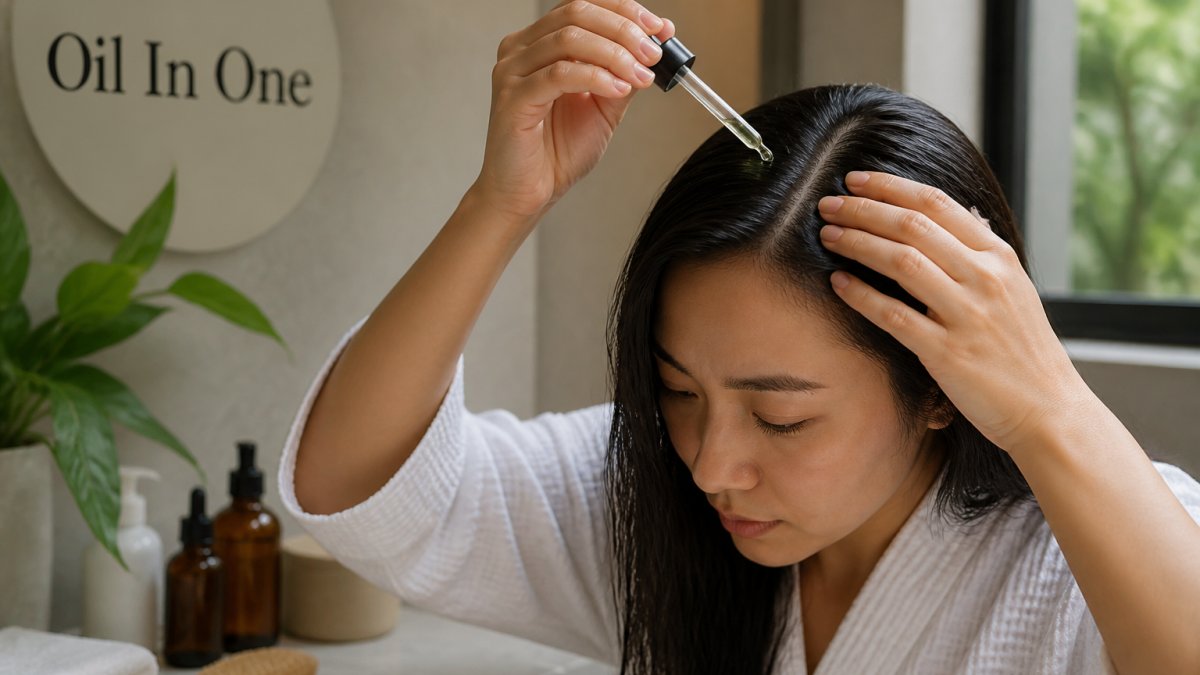
Follow these steps:
- Patch test first. Apply a small amount behind your ear or on your inner wrist. Wait 24 hours. No redness, no sting, proceed.
- Dilute essential oils properly. Roughly 1 to 2 drops of essential oil per tablespoon of carrier oil is a safe starting point.
- Part and apply. Use a dropper to place oil along the scalp in sections, not poured over the hair.
- Massage gently. Small circular motions for 3 to 5 minutes help distribute the oil and loosen surface buildup.
- Wait, then wash. Leave it on for at least 30 minutes, then rinse and shampoo once.
If you would rather skip the mixing, our Organic Scalp & Hair Oil is pre-blended with 11 botanicals, including rosemary, bhringraj and black seed oil, in a light jojoba and argan base at AED 120.00. Pair it with the Bamboo Scalp Massager (AED 60.00) to work the oil in evenly without tugging at your roots.


Oils to Avoid on the Scalp (and Why They Backfire)
Some oils to avoid on the scalp cause more harm than good, however natural they sound: mineral oil, heavy synthetic fragrance blends, and anything with undiluted essential oil. Mineral oil traps oil and debris, and synthetic fragrance is a common trigger for contact irritation. Neat essential oils are the other frequent mistake, tea tree, peppermint and rosemary applied straight can burn, sting, and leave the scalp redder than before.
How to read a scalp-oil label before you buy
Most itchy-scalp oils are sold on mood words, "calming," "soothing," "botanical." Ignore the front of the bottle and read the ingredient list:
- Carrier first. The first one or two ingredients make up most of the bottle. Jojoba or argan near the top suits an easily irritated scalp; mineral oil or a heavy plant butter signals a richer product for very dry scalps, not oily or buildup-prone ones.
- Essential oils by position, not by claim. Listed high, tea tree, peppermint, rosemary or lavender are likely meaningful in concentration; listed after fragrance or preservatives, they may be mostly for scent. Neither is automatically wrong, it tells you what you are buying.
- Fragrance and "parfum." An unnamed fragrance is the most common hidden irritant on a sensitive scalp. A scent listed as a named essential oil is easier to patch-test and rule out.
- Additives that sting. Alcohol denat, excess menthol and strong surfactants in a leave-on oil produce a tingle that feels like action but is irritation. Cooling is not calming.
- Vague blends. A "botanical blend" or "essential oil complex" that names nothing leaves you unable to know what you are reacting to. Transparent labeling is how you rule out triggers.
Concentration and dilution: what the label will not tell you
Pre-blended scalp oils rarely state their essential-oil percentage, so judge by position on the list and how the product feels. A blend that stings within a minute is too strong. Mixing your own, keep essential oils at roughly 1 to 2 drops per tablespoon of carrier oil, about 1%, and never apply a concentrate neat. For a first bottle, pick one whose essential oils sit low in the list and whose carrier is named, then patch-test.
Matching the Oil to Your Hair Type and Protective Style
The right oil for fine hair is not the right oil for coily hair or a beard. Fine, straight hair needs the lightest base, jojoba or a light pre-blend. Thick, coarse or curly hair carries richer oils like coconut or olive without looking greasy. In braids, twists or a weave, oil along the part lines and keep the length dry.
Match the base to texture and porosity
- Fine or low-porosity hair. A tight cuticle resists absorption, so heavy oils sit on top. Choose jojoba or a light pre-blend, use a dropper, and keep to a thin sheen along the part lines. Low-porosity scalps often do better with oil on slightly damp skin after washing.
- Medium to thick, wavy or curly hair. Jojoba and argan remain safe everyday picks; coconut or olive can be used as a richer pre-wash treatment once a week rather than a leave-in.
- Coily and tightly curled hair. The scalp is often dry while the lengths are fragile. Oil in sections, finger-detangle rather than brush, and a richer base such as coconut or a plant-butter blend may suit, but watch the hairline and nape, where buildup concentrates.
Frequency and wash-out by hair type
There is no single correct schedule, but a practical starting point is:
| Hair type | Typical frequency | Wash-out |
|---|---|---|
| Fine, straight, low porosity | Once or twice a week | Shampoo once; a light oil usually rinses clean |
| Medium, wavy | Two to three times a week | Shampoo once, focusing on the scalp |
| Thick, curly, coily | Two to three times a week, or as a pre-wash treatment | May need a conditioner-first rinse, then shampoo at the scalp |
| Braids, twists, weaves | Once or twice a week along part lines | Diluted shampoo on the scalp; keep the style dry |
If your scalp feels greasy the morning after application, you used too much or too heavy a base, halve the amount before changing products. If it feels tight and itchy again within a day, the base is too light or the frequency too low. Adjust one variable at a time.
Protective styles and the hairline
Braids, twists, cornrows and weaves trap oil and shed skin at the hairline and nape. Apply along exposed part lines with a dropper, massage with fingertips rather than nails, and blot excess. Do not oil the length under a weave or sew-in; it migrates to the scalp. Between styles, treat the scalp the day before wash day so a full wash-out follows.
Match the base to your hair, not to the trend. The best oil for your scalp is the lightest one that still calms the itch, applied often enough to help, and washed out often enough not to build up.
When to See a Professional About an Itchy Scalp
See a professional when an itchy scalp comes with spreading redness, sores, bleeding, sudden heavy shedding, or itching that keeps you awake, signs of an infection, eczema or hair loss that needs medical care.
An itchy scalp is manageable once you stop guessing and match the oil to the cause, the dilution to your skin, and the base to your hair.
Frequently Asked Questions
What oils are good for an itchy scalp?
Tea tree oil has the most evidence for itch linked to dandruff and flaking, while peppermint and lavender give a cooling, soothing effect. Carrier oils such as jojoba, argan and coconut oil add moisture without a heavy feel. A pre-wash blend that combines several botanicals, like Oil In One Organic Scalp & Hair Oil (AED 120), lets you apply one product three times a week rather than mixing your own. Always dilute essential oils in a carrier oil before applying.
Can tea tree oil help an itchy scalp?
Tea tree oil is not a cure for every cause of itching, and undiluted tea tree oil can burn or irritate skin. Mix 2 to 3 drops into a tablespoon of carrier oil, patch test behind the ear for 24 hours, and use it two to three times a week. If itching continues after four weeks, see a dermatologist.
How do you apply oil to an itchy scalp?
Part your hair in sections and use a dropper to place oil directly on the scalp, not the lengths. Massage with fingertips or a bamboo scalp massager for 3 to 5 minutes to spread it evenly and loosen surface buildup. Leave it on for at least 30 minutes, then shampoo out once. For most people, three applications a week is enough. Avoid scratching with nails, which can break the skin and let bacteria in.
What oils should not be used on the scalp?
Avoid mineral oil and heavy petroleum-based products, which sit on the surface and can trap flakes and sweat. Skip synthetic fragrance oils, which are a common trigger for contact irritation. Never apply undiluted essential oils such as oregano, cinnamon or clove, which cause burning and redness.
Should you leave scalp oil on overnight?
Overnight oiling is fine for dry, thick or coily hair, but keep it to once a week and use a light oil that absorbs rather than sits. For fine or oily hair, 30 to 60 minutes before washing is enough. Sleeping in heavy oil can clog follicles and stain pillows. If you wake with new itching or bumps, wash it out sooner and reduce the frequency.
