

How Often to Oil Scalp for Hair Growth: A 2026 Guide
Editorial TeamLast Updated: October 23, 2026
Quick Summary
How often to oil scalp for hair growth depends on your hair type: oil dry scalp two to three times per week, oily scalp once weekly or every 10 to 14 days, and balanced scalp twice per week. Oiling reduces breakage and strengthens hair at the root rather than making it grow faster, supporting visible length retention over time.
- Dry scalp needs two to three weekly treatments with 30 minutes to overnight leave-on time
- Oily scalp requires once weekly or every 10 to 14 days with 20 to 30 minutes leave-on time
- Balanced scalp benefits from twice weekly oiling with 30 to 45 minutes leave-on time
- Use about one teaspoon of oil, massage for two minutes per section, and shampoo thoroughly to prevent buildup
- Visible results take 8 to 12 weeks for reduced breakage and 3 to 6 months for length retention
Table of Contents
- How Often to Oil Scalp for Hair Growth: Frequency by Hair Type
- Does Oiling Your Scalp Help Hair Growth: What the Evidence Shows
- Building Your Scalp Oiling Routine: Application and Timing
- How Long to Leave Oil in Your Hair Before Washing
- Scalp Buildup from Hair Oil: Prevention and Management
- Choosing the Right Oil and Setting Realistic Expectations
- Common Mistakes to Avoid When Oiling Your Scalp
- Frequently Asked Questions
How Often to Oil Scalp for Hair Growth: Frequency by Hair Type
How often to oil scalp for hair growth depends on your hair and scalp. The frequency that supports growth for one person may create buildup for another, so match your routine to your hair type and scalp condition.
Your scalp produces sebum. Some scalps produce too little, leaving hair dry and breakage-prone; others produce too much, creating buildup. Most fall in the middle, shifting with climate, water quality, and biology.
Dry scalp and hair
For dry scalp, oil two to three times per week. Apply directly to the scalp, massage in gentle circles, and leave at least 30 minutes before washing; overnight oiling works well for dry hair.
Spacing treatments more than four days apart lets the scalp dehydrate again. Consistency matters more than intensity.
Oily scalp and hair
If your hair looks greasy by midday or your scalp feels slick within hours of washing, you have an oily scalp. Don't skip oiling, just use a lighter touch and longer spacing.
For oily scalp, apply oil once a week or every 10 to 14 days. Use about a teaspoon, focus on the scalp rather than the lengths, leave 20 to 30 minutes, then wash thoroughly.
Balanced scalp and normal hair
For balanced scalp and normal hair, two times per week is ideal. Massage oil into the scalp and leave 30 to 45 minutes before shampooing; add overnight oiling once a week for deeper conditioning.
Does Oiling Your Scalp Help Hair Growth: What the Evidence Shows
The relationship between scalp oiling and hair growth isn't straightforward.
Hair growth versus reduced breakage
A well-nourished scalp lets hair follicles function optimally, but oil doesn't make hair grow faster, it reduces breakage and prevents the damage that slows visible growth.
A dry, irritated, or inflamed scalp weakens strands at the root, so they break during washing, brushing, and styling. Consistent oiling calms inflammation, seals in moisture, and protects strands, less breakage, more length retention.
Scalp health as the foundation
Hair follicles live in your scalp. If it's inflamed, dry, or clogged with buildup, follicles produce weaker hair or enter a resting phase prematurely.
Oiling moisturizes, reduces inflammation, and creates an environment where follicles can work. Consistency matters more than the specific oil you choose.
Building Your Scalp Oiling Routine: Application and Timing
Most failed oiling routines come down to technique: too much product, incorrect application, or not leaving it on long enough.
How to apply oil to the scalp
Start with roughly a teaspoon, slightly more for thick or long hair. Warm it between your palms for a few seconds; warm oil absorbs better.
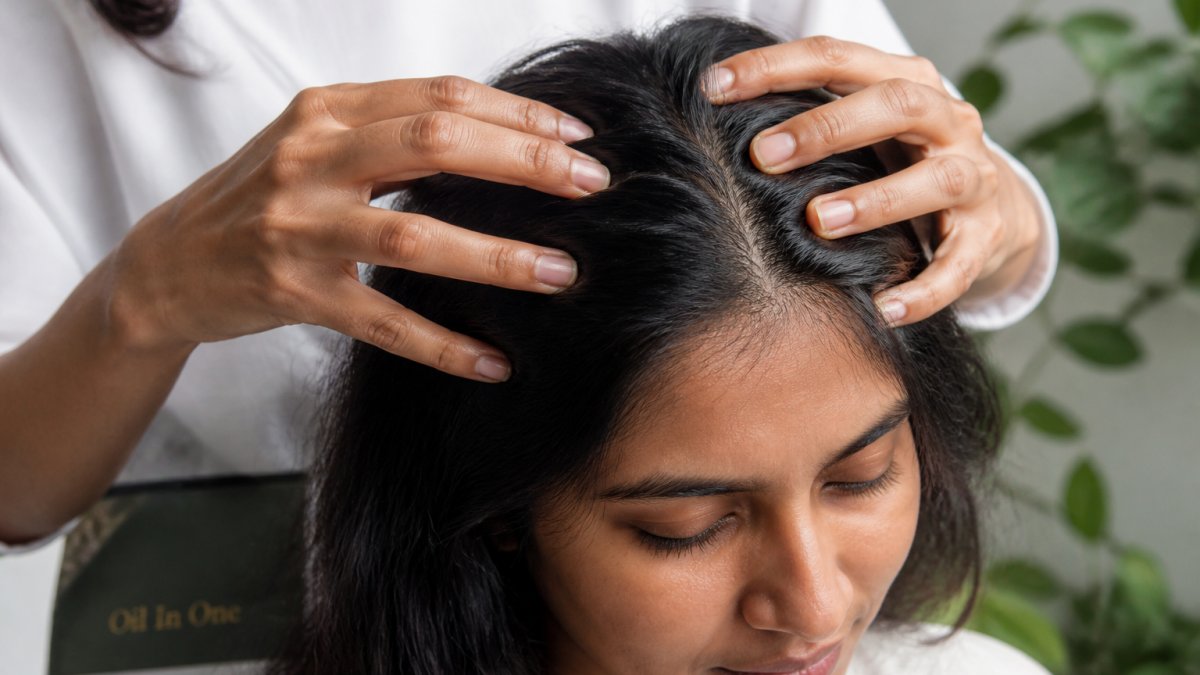
Part hair into four sections and apply oil directly to the scalp in each. Using fingertips, not nails, massage in slow circles for about two minutes per section to distribute oil and stimulate blood flow.
Pre-wash treatment versus leave-in application
Pre-wash treatment means applying oil, leaving it on at least 30 minutes, then washing it out.
Leave-in application means applying a few drops to the scalp after shampooing and conditioning without rinsing. It suits very dry scalps needing daily hydration or maintenance on non-oiling days.
Most people benefit more from the pre-wash approach, which allows enough product to actually nourish the scalp.
How Long to Leave Oil in Your Hair Before Washing
Absorption time matters: too short and the oil doesn't penetrate enough to benefit your scalp; too long and you risk buildup.
Minimum time for absorption
The absolute minimum is 20 minutes, but 30 minutes is the sweet spot for most people, long enough for meaningful absorption, short enough to fit into a typical day.
If you're doing a pre-wash treatment during your workday, apply the oil, set a timer for 30 minutes, then shampoo. Your scalp will feel nourished without the oil sitting so long that it oxidizes or attracts dust and debris.
Overnight oiling and when to use it
Leaving oil on overnight, typically 8 to 12 hours, gives it maximum time to work. It's ideal for:
- Dry, flaky, or irritated scalps that need intensive hydration
- Hair that's severely damaged or prone to breakage
- Scalps that haven't responded to shorter treatment times
The trade-off: protect your pillowcase with an old case or a cotton cloth, then shampoo thoroughly in the morning, you may need two applications to remove all the oil.
Start with overnight oiling once a week if your scalp is very dry, increasing to twice weekly if it helps. For balanced scalps, once every two weeks is usually enough.
Scalp Buildup from Hair Oil: Prevention and Management
This is where many people give up on scalp oiling. They experience buildup, a waxy, sticky residue that makes hair look dull and weighed down, and assume oiling doesn't work for them. In reality, buildup is usually a sign of incorrect application or washing technique, not that the oil itself is wrong.
What causes buildup and how to recognise it
Buildup happens when oil isn't fully removed during shampooing.
Buildup also happens when you use too much oil for your hair type, or when you don't shampoo thoroughly enough after your treatment.
To prevent it:
- Use the right amount of oil for your hair type (start small and add more only if needed)
- Always shampoo after your pre-wash treatment, using enough water and product to fully rinse
- Don't apply oil to your hair lengths if you have oily or normal hair
If buildup has already formed, use a clarifying shampoo once to remove the residue, then return to your regular routine with adjusted frequency or amount.
When to avoid oiling and scalp conditions to watch
Scalp oiling is beneficial for most people, but there are situations where you should pause or avoid it.
Avoid oiling if:
- Your scalp has active fungal or bacterial infection (see a dermatologist first)
- You have severe scalp psoriasis or eczema (unless your dermatologist recommends it)
- You're experiencing acute inflammation, redness, or pain on your scalp
Use caution if:
- You have very fine or thin hair (use minimal product and longer spacing)
- You're prone to product sensitivities (patch test first on a small area)
- You live in an extremely humid climate (buildup may form more easily)
If you have a scalp condition like eczema or psoriasis, talk to a dermatologist before starting a scalp oiling routine. Some oils can help, but others may irritate sensitive skin.
Choosing the Right Oil and Setting Realistic Expectations
Not all oils are the same. The oil you choose affects both how well your routine works and how your scalp responds.
Oil type and ingredient selection
The best scalp oils are lightweight and won't sit heavy on your hair.
At Oil In One, we formulated our Organic Scalp & Hair Oil with 11 botanicals including rosemary oil, bhringraj oil, pumpkin seed oil, onion seed oil, and black seed oil.

When choosing an oil, check the ingredient list. You want to see:
- Named botanical oils (not "fragrance" or "parfum")
- No mineral oil or silicones (these coat your hair and prevent moisture absorption)
- No synthetic fragrance (essential oils are fine; synthetic fragrance often indicates lower-quality formulations)
The price difference between oils usually reflects ingredient quality and formulation. A cheaper oil might work, but it often contains fillers or heavy bases that create buildup more easily.
Measuring results and timeline for visible change
Here's what most guides get wrong: expecting visible results too quickly. Hair growth is slow, a single hair takes months to grow noticeably longer. What you should expect to see:
- Within 2 weeks: Your scalp feels less tight or itchy. Flaking reduces.
- Within 4 weeks: Your hair feels softer and more manageable. Frizz may decrease.
- Within 8 to 12 weeks: You notice less breakage during washing and brushing. Hair looks healthier overall.
Don't expect thicker hair overnight. What you're seeing is reduced breakage and better scalp health, which means your hair can grow longer without snapping off. Track your progress by taking photos every four weeks. Look at your scalp (is it less flaky?), your hair texture (is it softer?), and your hair length (are you retaining more length?).
Common Mistakes to Avoid When Oiling Your Scalp
Most people sabotage their own routines without realizing it.
Using too much oil. A little goes a long way.
Not shampooing thoroughly. After your pre-wash treatment, shampoo twice if needed.
Expecting results too quickly. Hair growth takes time.
Choosing oil based on price alone. Cheaper oils often contain fillers or heavy bases.
Oiling too frequently for your scalp type. If you have oily hair and you're oiling three times a week, you're working against your scalp's natural balance. Match your frequency to your actual scalp condition.
Skipping the massage. Simply pouring oil on your scalp and leaving it isn't enough.
Getting your scalp oiling routine right takes a bit of experimentation, but the payoff is real. Use it as a pre-wash treatment three times a week, and pair it with our Bamboo Scalp Massager at AED 60.00 to enhance the massage technique. Within weeks, you'll notice your scalp feels healthier and your hair breaks less. Shop Oil In One and start seeing the difference a scalp-first approach actually makes.

Frequently Asked Questions
How many times per week should you oil your scalp for hair growth?
Most people see the best results oiling their scalp 2-3 times per week. Dry scalps and hair types benefit from 3 times weekly, while oily scalps do better with once or twice weekly. Start with twice weekly and adjust based on how your scalp feels and looks. Consistency matters more than frequency; a regular routine at the right interval for your scalp type will support hair growth better than sporadic applications.
Does oiling your scalp actually help hair growth?
Oiling supports scalp health, which creates conditions for hair to grow, but it does not directly make hair grow faster. A healthy scalp free of dryness, flaking, and irritation allows hair follicles to function properly. Regular scalp oiling also reduces breakage by sealing moisture into hair strands and strengthening them. The Organic Scalp & Hair Oil (AED 120) contains botanicals like rosemary and bhringraj that nourish the root and balance the scalp, supporting this foundation for growth.
How long should you leave oil on your scalp before washing it out?
Leave oil on your scalp for at least 30 minutes before washing. This gives the botanicals time to absorb and nourish the scalp and hair follicles. Many people apply oil in the morning and wash it out in the evening, or apply it before bed and wash the next morning. Overnight oiling is optional but can deepen the treatment if your scalp tolerates it. Wash out with your regular shampoo once; a light oil base like jojoba and argan should rinse cleanly without needing multiple washes.
Can oiling your scalp cause buildup or make dandruff worse?
Buildup happens when too much oil sits on the scalp or when you oil too frequently for your scalp type. If your scalp is already oily or prone to flaking, oiling more than once weekly can worsen it. Start conservatively and increase frequency only if your scalp feels dry. If you notice residue, itching, or flaking after oiling, reduce frequency or switch to a lighter application. Eczema-prone scalps should be tested with a small amount first.
