

Protect Your Hair From Sand and Sun
Editorial TeamLast Updated: October 25, 2026
Quick Summary
To protect hair from sand and sun, apply a leave-in UV product and scalp sunscreen (SPF 30 or higher) before the beach, wear a wide-brimmed hat or scarf as your primary shield, and reapply scalp sunscreen every two hours and after swimming. Deep condition 24 hours before, use a protective hairstyle to reduce exposed surface area, and rinse with fresh water immediately after swimming to remove salt and sand.
- Apply scalp sunscreen SPF 30 or higher to your part line, hairline, and temples separately from hair products.
- Reapply scalp sunscreen every two hours and immediately after swimming, even on cloudy days.
- A wide-brimmed hat or breathable scarf is the single most effective protection step for both hair and scalp.
- Remove sand by rinsing with fresh water first, then applying conditioner for slip before finger-detangling, never brushing dry sand-filled hair.
- Deep condition twice a week for 7 days after beach exposure to restore moisture and repair sun damage.
Table of Contents
- Why Sun Exposure and Sand Damage Hair
- How to Protect Hair From Sun Damage Before You Go
- Protecting Coloured Hair From the Sun at the Beach
- Your Beach Hair Care Routine: Before, During, and After
- How to Remove Sand From Hair Effectively
- Recovery and Moisture After Sun and Sand Exposure
- Start Your Hair Protection Routine Today
- Frequently Asked Questions
Why Sun Exposure and Sand Damage Hair
Sun exposure damages hair in multiple ways. UV rays break down the proteins that hold hair strands together, making them brittle and weak.
The scalp suffers too. Direct sun exposure burns the scalp, causing inflammation and flaking. This weakens hair roots and slows growth.
Heat intensifies the damage. High temperatures open the hair cuticle, allowing moisture to escape. Hair becomes dry, frizzy, and prone to breakage.
Most people wait until after the beach to address the damage. By then, the harm is already done. The better approach is prevention: start your protection routine before you leave home.
Research on UV damage to hair structure
How to Protect Hair From Sun Damage Before You Go
Pre-beach protection works on two separate targets: the scalp (living skin that burns and inflames) and the hair fibre (dead keratin that photo-degrades and loses colour). Most advice treats them as one, which is why people end up with a burned part line and still-faded ends. Treat them separately and the routine becomes clearer.
What UV protection can and cannot do
A leave-in product with UV filters can slow colour fading and reduce protein loss in the hair fibre. It cannot fully block UV damage, and no rinse-off conditioner offers meaningful protection once you are in the water. For the scalp, the only reliable protection is physical coverage (hat, scarf, or a leave-in sunscreen designed for skin) plus shade. Hair products are not a substitute for scalp sunscreen. This distinction matters: a UV hair spray protects the fibre, not the skin at your part line.
Your pre-beach sequence (24 hours out)
Step 1: Deep condition 24 hours before (not the morning of). Apply a nourishing mask to damp hair, mid-lengths to ends, for 10-15 minutes.
Step 2: Apply a leave-in UV product to damp hair. Use a leave-in conditioner or UV-protective spray on damp, not soaking, hair.
Step 4: Choose a low-friction protective style. A high bun, loose braid, or twisted updo reduces exposed surface area and keeps sand out of the ends.
Step 5: Hat or scarf as the primary shield. A wide-brimmed hat or a breathable scarf blocks direct UV on both hair and scalp. This is the single most effective step.
Reapplication schedule at the beach
| Time | Action |
|---|---|
| On arrival | Confirm hat/scarf is on, scalp sunscreen applied |
| Every 2 hours | Reapply scalp sunscreen to part line and hairline |
| After every swim | Reapply scalp sunscreen, re-tie hair into protective style |
| Before leaving | Rinse hair with fresh water if possible |
What to skip
- Do not rely on hair oil as sun protection for the scalp.
- Do not apply heavy product to the roots before a beach day, it traps sand and weighs hair down.
- Do not leave hair loose if wind and sand are strong, loose hair acts as a sand trap.
Research on UV damage to hair structure
Protecting Coloured Hair From the Sun at the Beach
Colour-treated hair needs extra protection. UV rays fade hair colour by breaking down the pigment molecules. Sun exposure can turn brunette hair brassy, blonde hair yellow, and red hair orange.
The damage happens faster in salt water. Saltwater opens the hair cuticle and allows UV rays to penetrate deeper into the hair shaft. This accelerates colour fading.
Protect colour-treated hair with these steps:
- Use a UV-protective product designed for coloured hair before going to the beach
- Wear a hat whenever possible to block direct sunlight
- Rinse hair with fresh water immediately after swimming to remove salt
- Deep condition colour-treated hair twice a week after beach visits
- Avoid swimming in chlorinated pools for at least 48 hours after beach exposure
Colour-treated hair is more porous than untreated hair. It absorbs and loses moisture faster. This makes it more vulnerable to dryness and breakage from sun and sand exposure.
Your Beach Hair Care Routine: Before, During, and After
A complete routine protects your hair at every stage of the beach experience.
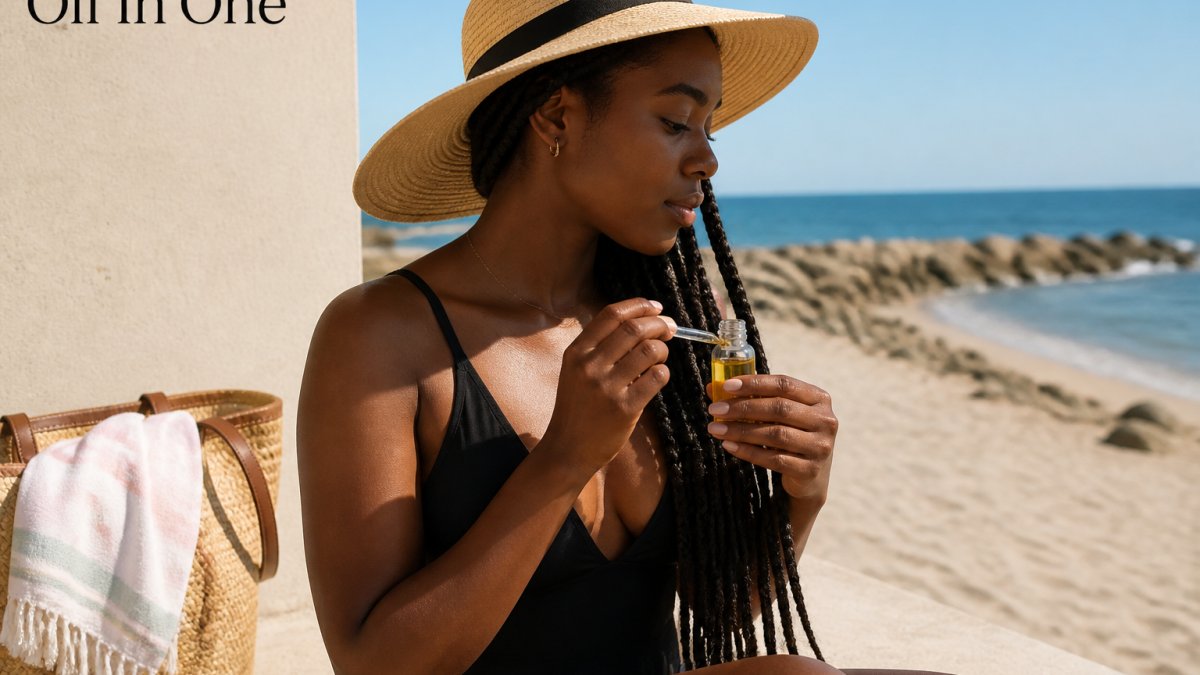
Before you go: Apply a leave-in conditioner and protective oil to damp hair. Braid or bun your hair to reduce tangling.
While you're at the beach: Keep your hair in a protective hairstyle. Wear your hat when out of the water.
After you leave: Rinse your hair thoroughly with clean water. Use a nourishing conditioner to restore moisture and repair sun damage.
A complete routine like this prevents most beach-related hair damage. The key is consistency. One missed step can undo the protection from all the others.
How to Remove Sand From Hair Effectively
Sand is abrasive. Every grain that stays in your hair while you comb, brush, or sleep acts like a tiny file against the cuticle. The goal is not to scrub harder, it is to lift sand out with slip and water before friction does the damage.
The core principle: water first, slip second, fingers before tools. Dry sand on dry hair is the worst combination because the grains catch on raised cuticles. Wet sand on wet hair is easier to release, but only if you add a conditioner or oil to create slip. Never brush dry hair that contains sand.
Step-by-step sand removal sequence
- Rinse with fresh water before you touch your hair. Stand under running water for at least 60 seconds. This loosens surface sand and softens any salt or sunscreen residue. Do not rub your scalp with your nails at this stage.
- Apply a generous amount of slip conditioner. Choose a conditioner with high slip (look for ingredients like cetyl alcohol, behentrimonium methosulfate, or a silicone such as dimethicone). Apply from mid-length to ends first, then work a small amount near the scalp. Let it sit for 2-3 minutes.
- Detangle with your fingers, not a comb. Start at the ends and work upward in small sections. If you feel resistance, add more water and conditioner rather than pulling. Sand releases when it is lubricated, not when it is forced.
- Rinse each section separately. For long or thick hair, clip your hair into 4-6 sections and rinse one at a time. This prevents sand from redistributing back into clean sections.
- Repeat the conditioner step once if sand remains. A second application is normal after a windy beach day. Do not shampoo yet, shampoo strips the slip you need.
- Only then use a wide-tooth comb. Once the sand is visibly gone, comb from ends to roots with a wide-tooth comb while the conditioner is still in. Rinse thoroughly.
Hair-type adjustments
Fine or straight hair: Sand slides off more easily but fine hair tangles fast. Use a lightweight conditioner and avoid heavy oils that weigh hair down.
Curly hair (wavy to loose curls): Do not comb curls dry or while sand is present.
Coily or textured hair: Sand can lodge at the scalp and along the hair shaft.
Colour-treated or chemically treated hair: These fibres are more porous and roughened, so sand catches more easily.
Long hair: Sectioning is not optional. Sand that stays in the middle of a long section will redistribute during rinsing. Clip each section, condition, finger-detangle, and rinse individually.
What not to do
- Do not brush or comb dry hair that contains sand.
- Do not scrub the scalp with fingernails, this pushes sand into follicles and causes irritation.
- Do not use a fine-tooth comb on wet, sand-filled hair.
- Do not skip conditioner to save time, slip is what protects the cuticle.
Recovery and Moisture After Sun and Sand Exposure
Sun and sand exposure depletes moisture from your hair. Recovery starts immediately after you get home from the beach.
Day 1 after beach exposure: Shampoo gently to remove any remaining sand or salt. Use a hydrating conditioner and leave it on for 5-10 minutes.
Days 2-3: Skip shampooing if possible. Use a complete hair care kit for growth to support recovery and restore strength to weakened roots.
Days 4-7: Resume your normal hair care routine. Use a nourishing conditioner 2-3 times this week.
Dry hair is fragile hair. It tangles, breaks, and splits more easily. Moisture is the foundation of healthy hair.
Dermatological research on post-sun hair recovery
Start Your Hair Protection Routine Today
You can protect hair from sand and sun on beach trips so they don't have to damage your hair.
Start before you go. Protect while you're there. Recover when you get home.
Our approach starts with scalp health, a healthy scalp grows stronger hair that resists damage better.
The article on why hair fall happens in the UAE and how to protect your hair naturally explains the environmental factors that make beach protection even more important in this climate.
Your hair can stay healthy, shiny, and strong even with regular beach visits. It takes consistency, but the results are worth it.
UV protection guidelines for hair health
Protecting your hair from sand and sun is about more than looking good. It's about maintaining healthy roots and strong strands year-round.
| Stage | Key Action | Timing | Best For |
|---|---|---|---|
| Before | Deep condition, apply leave-in protectant | 24 hours prior | All hair types |
| Before | Protective hairstyle, wear hat | At the beach | Long and textured hair |
| During | Rinse after swimming | Immediately | All hair types |
| After | Remove sand gently | While damp | All hair types |
| After | Deep condition | First 24 hours | Dry and damaged hair |
| Recovery | Moisture-focused routine | Days 2-7 | Post-beach repair |
Frequently Asked Questions
How do I protect coloured hair from sun damage at the beach?
Coloured hair fades faster under UV rays because the sun opens the hair cuticle and lifts pigment. Before the beach, apply a UV-protective product or oil to seal the cuticle. Wear a hat or protective style like a braid or bun to minimise direct exposure. Rinse immediately after swimming with clean water to remove salt and chlorine, which accelerate fading. Deep condition every two days after beach days to restore moisture and lock in colour.
Should I wet my hair with fresh water before swimming in the sea?
Yes. Wetting your hair with clean water before entering saltwater or chlorinated pools reduces how much salt or chlorine your hair absorbs. Dry hair acts like a sponge and soaks up damaging minerals. Pre-wetting fills the hair shaft with fresh water first, creating a barrier. This simple step significantly reduces salt and chlorine penetration and makes post-swim rinsing more effective.
What is the best way to remove sand from hair after the beach?
Rinse thoroughly with clean water first to loosen surface sand. For fine or curly hair, use a wide-tooth comb gently while rinsing to detangle sand particles without breakage. For thicker or straighter hair, a gentle shake and continued rinsing often removes most sand. Avoid harsh brushing when hair is wet and sandy, as friction causes breakage. After rinsing, apply a leave-in conditioner or oil to smooth the cuticle and trap remaining particles, making them easier to wash out later.
Can I prevent sun damage to my hair, or can I only treat it after?
You can prevent most sun damage with preparation. UV rays damage the protein structure of hair, causing colour fading and dryness. Wear a hat or protective hairstyle, apply UV-protective products before beach time, and rinse immediately after swimming. These steps stop damage before it happens. Once damage occurs, conditioning and moisture seal the cuticle to prevent further deterioration, but the structural damage cannot be reversed. Prevention is far more effective than repair.
