

7 Scalp Care Mistakes Women Make With Natural Oils
Editorial TeamQuick Summary
The best scalp care products for women depend on the main concern: dryness, itch, flaking or thinning-related shedding. Light, moisturising oils suit dry scalps, calming ingredients with gentle cleansing suit itchy ones, and formulas that loosen buildup without stripping the skin suit flaking. Change one product at a time and give it several weeks.
- Apply light oil to a dry scalp at least once a week, parting the hair in sections.
- Use anti-dandruff shampoo two to three times a week, since daily use can dry the skin further.
- Massage the shampoo into the scalp, not the lengths, and rinse thoroughly.
- Exfoliate once a month, or every two weeks for oily scalps, using light pressure.
- See a doctor for sudden or patchy hair loss, painful or bleeding skin, or spreading redness.
Table of Contents
- Scalp Care Products for Women: How to Choose by Scalp Concern
- Scalp Treatment for Dry Scalp: What Actually Helps
- Anti-Dandruff Shampoo for Women: Choosing the Right Formula
- Scalp Oil for Itchy Scalp: Light Botanical Options
- Scalp Exfoliator: When It Helps and When It Irritates
- A Simple Scalp Routine and the Right Product Order
- When Scalp Symptoms Need a Doctor's Visit
- Building Your Scalp Care Routine With Oil In One
- Frequently Asked Questions
Scalp Care Products for Women: How to Choose by Scalp Concern
Last Updated: November 2, 2026
Scalp care products for women are not one-size-fits-all. A product that calms a dry scalp can make an oily one worse, and a heavy oil that suits thick, coily hair can weigh down fine strands. The right choice starts with identifying your main concern: dryness, itch, flaking, or thinning-related shedding. Oil In One builds its routines around the scalp first, using botanical ingredients chosen for a clear purpose.
Start by matching the product to the problem. Dry, tight scalps usually respond to light, moisturising oils applied to the roots before washing. Itchy scalps often need calming ingredients and gentle cleansing. Flakes call for a formula that loosens buildup without stripping the skin.
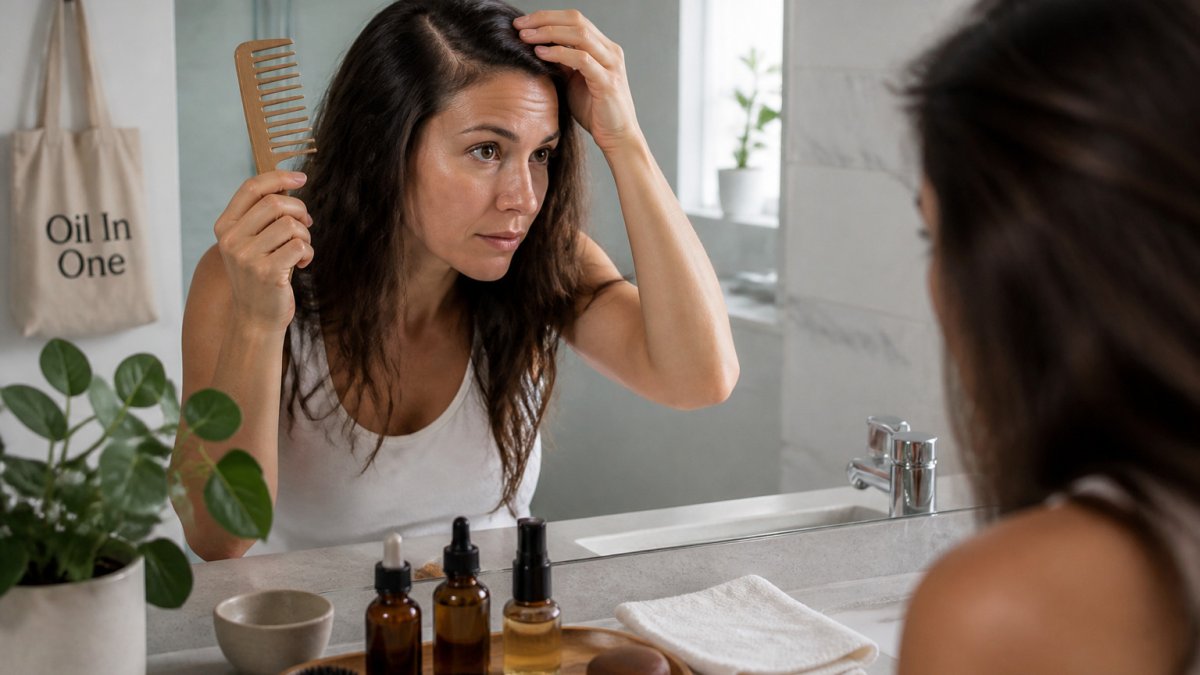
Many women try several products at once and cannot tell which one helped. Change one thing at a time and give it several weeks. A common mistake is layering a new oil, serum and scrub together, then blaming whichever product seemed to cause a reaction.
Scalp Treatment for Dry Scalp: What Actually Helps
A dry scalp feels tight, looks dull and may flake in small white pieces. The guide on choosing hair care products for dry scalp walks through how to select products for this concern. The goal is to add moisture and reduce irritation rather than to scrub the skin harder.
Apply a light oil to the scalp at least once a week, parting the hair in sections so the oil reaches the skin. Leave it on for a period before washing, then cleanse with a gentle shampoo. Avoid harsh exfoliation while the skin is already dry, because it can make irritation worse.
If you have fine hair, use a smaller amount and focus on the scalp, not the lengths.
Anti-Dandruff Shampoo for Women: Choosing the Right Formula
Dandruff is common, but the cause is not always the same. Some cases come from a dry scalp, others from oiliness or sensitivity, and some from a yeast-like organism that feeds on sebum. An anti-dandruff shampoo can help, but using it every day may dry the skin further, and using the wrong active for your type of flaking can leave you cycling through bottles with no result.
Match the Active to the Flake
Most anti-dandruff shampoos rely on one of a small number of actives. Knowing what each does makes the label readable:
- Zinc pyrithione slows the growth of the organism associated with dandruff and is generally well tolerated. It suits mild, persistent flaking and can be used two to three times a week.
How to Use It Without Over-Drying
Massage the shampoo into the scalp, not the lengths, and leave it on for the time stated on the label, usually a few minutes, before rinsing. Conditioner belongs on the mid-lengths and ends, not the roots, where it can trap residue. If your scalp feels tight after washing, you are either using the shampoo too often or the formula is too harsh for your skin.
Watch out: rotating three or more anti-dandruff actives in the same week makes it impossible to tell which one is helping and which is irritating.
Reading Ingredient Labels for Irritants
Ingredient lists show what a product contains, in order of concentration. Strong fragrance, certain preservatives and high concentrations of alcohol can irritate sensitive scalps. Patch-testing any new product on a small area of skin first is a sensible precaution. If flaking persists or the skin is red, painful or weeping, speak to a doctor or dermatologist rather than continuing to experiment.
Scalp Oil for Itchy Scalp: Light Botanical Options
An itchy scalp has many possible causes, including dryness, product buildup and sensitivity. The step-by-step guide to soothing an itchy scalp naturally covers what to try first. Choosing a light botanical oil can soothe the skin, but it should not be applied to broken or inflamed skin. A light botanical scalp oil option is one place to compare formulas for this purpose.
If the itch continues for more than a few weeks, see a healthcare professional to rule out a skin condition.
Scalp Exfoliator: When It Helps and When It Irritates
A manual tool can help, but pressure matters. Scrubbing hard on an already irritated scalp often makes flaking and itch worse.
Stop using any exfoliator that causes stinging, bleeding or lasting redness.
A Simple Scalp Routine and the Right Product Order
A workable routine has four steps: cleanse, treat, massage and rinse. Apply any pre-wash oil first, then shampoo, then a leave-on treatment if you use one. Massage the scalp with a bamboo scalp massager for three to five minutes, which can help distribute oils across the skin. A bamboo scalp massager can be used during shampooing or oil treatments. Use the massager during shampooing or oil treatments.

Order matters. Putting heavy products on the scalp before a gentle cleanse can trap residue. Keep the sequence consistent for four to six weeks before judging results.
Wash-Day Order, Step by Step
- Pre-wash oil (once a week, or twice if the scalp is very dry). Part the hair in sections and apply a few drops directly to the scalp, not the lengths. Leave it on for twenty to thirty minutes, or longer for a coily texture that needs more softening time.
- Exfoliation (once a month, or every two weeks for oily scalps). Use a gentle scrub or a wooden scalp comb during the oil stage or during shampooing. Apply light pressure in small circles; the goal is to loosen residue, not to scrub the skin.
- Shampoo. Emulsify the shampoo in your hands first, then work it into the scalp with fingertips. Rinse thoroughly, leftover product is a common cause of itch and buildup.
- Leave-on treatment. A light serum or tonic goes on the scalp after towel-drying. Use it sparingly; a few drops are enough for most scalps.
- Conditioner. Keep it on the mid-lengths and ends, away from the roots.
Between-Wash Steps
On non-wash days, a dry scalp benefits from a small amount of light oil or serum on the roots, applied with clean hands. An oily scalp usually needs nothing between washes beyond a quick massage to lift buildup. If you use a scalp massager daily, keep it clean and stop if the skin feels tender.
Adjusting for Texture and Life Stage
A routine that suits fine, straight hair can overwhelm thick, coily hair, and the reverse is also true. Women with protective styles such as braids or twists should focus on keeping the scalp clean and moisturised without disturbing the style, and should avoid heavy oils that attract lint. Postpartum and menopausal hormonal shifts can change sebum production and sensitivity, so a routine that worked before may need to be simplified. None of this means one routine suits everyone, start with one concern, add one product at a time, and give each change four to six weeks.
Watch out: layering a new oil, serum and scrub in the same week makes it impossible to tell which product helped and which caused a reaction.
The wash-day sequence below summarises the order and timing described in this section.
| Step | What to do | Time or frequency |
|---|---|---|
| Pre-wash oil | Apply a few drops to the scalp, not the lengths | Once a week, or twice if very dry |
| Exfoliation | Gentle scrub or wooden comb, light pressure | Once a month, or every two weeks if oily |
| Shampoo | Emulsify in hands, work into scalp, rinse thoroughly | Each wash |
| Leave-on treatment | Light serum or tonic after towel-drying | A few drops |
| Conditioner | Apply to mid-lengths and ends only | Each wash |
When Scalp Symptoms Need a Doctor's Visit
Most scalp issues respond to changes in routine, but some signs need medical attention. See a doctor if you notice sudden or patchy hair loss, painful or bleeding skin, spreading redness, or symptoms that do not improve after several weeks of gentle care. Women going through pregnancy, menopause or other hormonal changes should also discuss persistent symptoms with a healthcare professional.
Building Your Scalp Care Routine With Oil In One
Start with one concern, choose one product, and use it consistently. Oil In One's routines are simple and transparent, with each ingredient chosen for a clear purpose. Shop the range and build from what your scalp tells you.
Frequently Asked Questions
How often should women use scalp treatments?
Most scalp treatments are used once or twice a week, while dry or itchy scalps may need a leave-on oil two to three times weekly. Start at the lower frequency and watch how your scalp responds over four weeks. If redness, burning or increased flaking appears, reduce use or stop and check the product's directions. Adjust based on how your scalp feels rather than following a fixed schedule.
Are natural oils suitable for every scalp type?
Not every scalp reacts well to every botanical. Oily scalps may find heavy oils build up, while sensitive or eczema-prone scalps can react to essential oils and certain plant extracts even when they are natural. Patch test any new product on a small area of skin behind the ear for 48 hours before full use. Look for simple, transparently labelled formulas, and remember that 'natural' does not mean hypoallergenic. If irritation persists, stop use and consult a dermatologist.
What ingredients should I look for in a scalp care product?
Look for ingredients chosen for a clear purpose, such as aloe vera or light botanical oils for soothing and moisture, and fully listed ingredient names rather than vague descriptions. Check whether the product matches your concern: moisturising formulas suit dry scalps, while exfoliating or anti-dandruff ingredients suit flaky scalps. Be cautious with fragrances and essential oils if your skin reacts easily. A short ingredient list makes it easier to identify what may be causing irritation.
How can I tell whether my scalp is dry or has dandruff?
Dry scalp usually produces small, white, powdery flakes and tightness, often with itching that worsens in dry air or after washing too often. Dandruff tends to produce larger, oilier flakes, with redness or greasy patches, and is often linked to a yeast-related condition on the scalp. Both can overlap, so track your symptoms for a few weeks. If flaking is persistent, painful, spreading or causes hair loss, book a visit with a dermatologist in the UAE rather than relying on products alone.
