

Can You Actually Read a Botanical Hair Oil Label?
Editorial TeamLast Updated: November 20, 2026
Quick Summary
To read a botanical hair oil label, ignore the front panel and read the ingredient list, which ranks ingredients from highest to lowest concentration. Translate INCI names, check where the hero plant sits, and scan for fragrance, parabens, and sulfates before buying.
- Ingredients are listed highest concentration first, so the first five positions reveal the real formula.
- A plant named on the front but listed at position nine is present in trace amounts, not strength.
- Copy the exact INCI name and check it against a public safety database before buying.
- Nut oils like sweet almond and hazelnut appear under Latin INCI names that never say nut.
- Opaque or amber glass and pump dispensers slow oxidation better than clear bottles and droppers.
Table of Contents
- Why the Ingredient List Matters More Than the Front Label
- How Ingredient Order Reveals What a Botanical Hair Oil Really Contains
- Decoding INCI Names for Hair Oil Ingredients
- Carrier Oils for Hair and Scalp: The Base of Every Blend
- Essential Oils in Hair Products: Scent, Strength, and Sensitivity
- Hair Oil Ingredients for Sensitive Scalp: What to Scan For and Skip
- Harsh Chemicals, Preservatives, and Fragrance: What to Avoid
- Shelf-Life, Oxidation, and Extraction: Reading the Fine Print
- A Seven-Step Routine for Checking Any Hair Oil Label
- Choosing a Botanical Hair Oil You Can Actually Trust
- Frequently Asked Questions
Why the Ingredient List Matters More Than the Front Label
The front of a bottle sells a feeling. The back tells you the truth. If you want to know how to read botanical hair oil ingredient labels, start by ignoring every word on the front panel and turning the bottle around.
Oil In One lists every ingredient in plain language, so you can see what the bottle contains. The back label is where a brand either shows its work or hides it.
A bottle can call itself "natural" while carrying deodorized oils. The front says botanical; the back label shows what is actually inside. Below, we walk through how to spot that gap in under a minute.
How Ingredient Order Reveals What a Botanical Hair Oil Really Contains
Ingredient lists follow one rule: highest concentration first, lowest last. That single rule does more work than any marketing claim on the shelf.
So when a botanical hair oil lists its hero plant at position nine, behind water, alcohol, and three silicones, you now know what you are actually buying. The label is not lying. It is ranking.
The First Five Ingredients Tell Most of the Story
Reading the first few positions gives you a good sense of the formula.
- Position 1-2: the base. Usually a carrier oil or water.
- Position 3-5: the supporting cast. Other carriers, emulsifiers, or actives.
- Position 6 and beyond: trace amounts. Often under one percent.
A common mistake is assuming a plant named on the front is a main ingredient. Check its position. If rosemary sits at the bottom of the list, the bottle carries rosemary's scent, not its strength.
Decoding INCI Names for Hair Oil Ingredients
INCI stands for International Nomenclature of Cosmetic Ingredients, the standard naming system used on cosmetic labels worldwide. It gives every ingredient one universal name, so a buyer can compare two bottles from two brands without guessing.
The catch: INCI names are Latin-ish and unfriendly. Once you learn five or six, the back label stops looking like code. But the real skill is not translation, it is using those names to cross-reference what is actually in the bottle.
Botanical Names vs. Common Names on the Label
Here is a quick translation table we keep handy:
| INCI Name | What It Actually Is |
|---|---|
| Rosmarinus Officinalis Leaf Oil | Rosemary oil |
| Ricinus Communis Seed Oil | Castor oil |
| Simmondsia Chinensis Seed Oil | Jojoba oil |
| Argania Spinosa Kernel Oil | Argan oil |
| Cocos Nucifera Oil | Coconut oil |
| Tocopherol | Vitamin E, a natural antioxidant |
Once you can read these names, the next question is whether the oil behind the name is organic or synthetic. Our guide on organic vs synthetic oils breaks down that difference in plain terms.
How to Cross-Reference an INCI Name Against Safety Data
Most guides stop at translation. The more useful move is to take the INCI name and check it against a public safety database before you buy. The pattern most practitioners follow is simple:
- Copy the exact INCI name from the label, not the marketing name.
- Search that exact string in a cosmetic ingredient database or the supplier's safety data sheet.
- Note the reported function (emollient, fragrance, preservative, antioxidant) and any listed restrictions or concentration limits.
- Compare that function to where the ingredient sits in the list. A preservative at position two is a very different product from a preservative at position ten.
This is where INCI earns its keep: because the name is universal, the safety data you find applies to the same substance in every bottle, regardless of brand. A common pattern is that an ingredient marketed as a "botanical extract" appears in the database as a fragrance allergen or a solvent, the INCI name is what exposes that.
Watch out: some labels list a trade name or a blend name rather than the INCI name. If you cannot find the exact string in a database, the brand is either using a proprietary blend or hiding behind a marketing term, and both are worth questioning.
Allergy-Specific Scanning: Botanical Allergens Hidden Under Generic Terms
If you have a known allergy, the INCI list is your screening tool, but only if you know which names to scan for. Botanical allergens are frequently buried under names that do not sound like the thing you are allergic to.
- Nut-derived oils: look for Prunus Amygdalus Dulcis Oil (sweet almond), Corylus Avellana Seed Oil (hazelnut), Prunus Armeniaca Kernel Oil (apricot kernel), and Macadamia Ternifolia Seed Oil. None of these say "nut" on the label.
- Seed and grain oils: Triticum Vulgare Germ Oil (wheat germ) and Sesamum Indicum Seed Oil (sesame) are common in botanical blends and are frequent allergens.
- Essential-oil allergens: Limonene, Linalool, Citronellol, and Geraniol are individual fragrance compounds that must be declared in many markets when they exceed set thresholds. They can appear even in products labelled "fragrance-free."
- Generic terms to distrust: "botanical extract," "plant oil," and "essential oil blend" tell you nothing. If the label will not name the plant in INCI form, you cannot screen it.
A practical habit: keep a short personal list of your allergen INCI names on your phone and scan the back label against it before you read anything else. It takes thirty seconds and catches the hidden cases that the front label is designed to gloss over.
If you have reacted before, do not test on your scalp first. Our guide on how to patch test scalp oil safely walks through the arm test step by step.
Carrier Oils for Hair and Scalp: The Base of Every Blend
Carrier oils for hair and scalp make up the bulk of any blend. They carry the active botanicals, seal moisture into the strand, and decide how the oil feels going on.
The base oil choice affects how a blend feels:
- Jojoba: light, close to the scalp's own sebum, absorbs fast.
- Argan: rich but not heavy, good for dry ends.
- Castor: thick and sticky, best blended rather than used alone.
- Pumpkin seed: light, popular in scalp-focused blends.
What most guides miss is that a heavy carrier makes a good formula feel greasy, no matter how pure it is. Texture is a formulation decision, not an accident. A light base is designed to rinse out easily and avoid weighing hair down.
Essential Oils in Hair Products: Scent, Strength, and Sensitivity
Essential oils in hair products do two jobs: they scent the blend and they bring plant compounds that support the scalp. Both jobs come with a caveat.
The caveat is strength. Essential oils are concentrated, and concentrated means a higher chance of reaction on sensitive skin. A blend that smells strongly of peppermint is telling you something about dose.
If rosemary is the oil you are curious about, read the evidence before trusting the label. Our breakdown of whether rosemary oil really helps hair growth covers what the clinical research actually says, so you can judge the claim rather than the copy.
A raw, herbal smell is often a good sign. It usually means the brand did not add fragrance to mask the botanicals.
Hair Oil Ingredients for Sensitive Scalp: What to Scan For and Skip
For a sensitive scalp, the ingredient list is a screening tool. Scan for these, in this order:
- Fragrance or parfum: the most common trigger. Skip it.
- Essential oils at high dose: fine for many, risky for reactive skin.
- Alcohol denat: drying over time.
- Silicones: not harmful, but they coat rather than treat.
- Preservatives: necessary in water-based products, worth checking in oils.
If you have reacted before, do not test on your scalp first. Our guide on how to patch test scalp oil safely walks through the arm test step by step.
Harsh Chemicals, Preservatives, and Fragrance: What to Avoid
The chemicals worth avoiding in a hair oil are fewer than the internet suggests. The real list is short.
- Parabens: common preservatives, debated, easy to avoid.
- Sulfates: cleansers, rarely found in oils, harsh on scalps.
- Synthetic fragrance: the biggest hidden irritant.
- Mineral oil: cheap, occlusive, and often deodorized.
Watch out: "fragrance-free" and "unscented" are not the same thing. Unscented products can still contain masking fragrance. If synthetic scent is what you want to dodge, our list of the best scalp oils without synthetic fragrance saves you the label hunt.
Deodorized oils are widely used in the industry. A raw herbal smell can indicate a botanical blend without masking fragrance.
Shelf-Life, Oxidation, and Extraction: Reading the Fine Print
Oils can oxidize over time, which makes them smell sharp and feel tacky. The label tells you how likely that is to happen and how fast.
The Mechanism: Why Some Botanical Oils Turn Faster Than Others
Not all oils oxidize at the same rate. The driver is the fatty-acid profile. Oils high in polyunsaturated fats, pumpkin seed, rosehip, evening primrose, have more sites where oxygen can attack, so they turn rancid faster. Oils high in monounsaturated or saturated fats, jojoba, argan, castor, coconut, are more stable and last longer.
That means a label listing a delicate seed oil at position two is telling you two things at once: the formula is potent, and the bottle has a shorter useful life than a jojoba-heavy blend. Neither is bad. They just require different handling.
Reading the Label for Stability Signals
Three label details tell you how stable a bottle is:
- Tocopherol or vitamin E: a natural antioxidant that slows oxidation. Its presence, especially alongside a delicate oil, is a sign the formulator thought about shelf-life.
- Cold-pressed: extraction without heat, which preserves more of the plant's sensitive compounds, but also leaves more of the compounds that oxidize, so cold-pressed oils often need antioxidant support.
- Solvent extraction: cheaper, but leaves less of the raw botanical behind and can leave solvent residues if not fully removed.
Watch out: a label that lists a delicate oil high in the formula but no tocopherol or other antioxidant is a stability risk, not a purity signal. The absence of an antioxidant is information too.
What the Label Will Not Tell You, and How to Read Around It
Most labels do not print a shelf-life date for the oil itself, only a batch or best-before code. The practical workaround is to read the packaging and the formula together:
- Opaque or amber glass slows light-driven oxidation. Clear bottles of delicate oils are a warning sign.
- Airless or pump dispensers limit oxygen exposure better than droppers, which let air in with every use.
- Smaller bottle sizes for delicate oils make sense; a large bottle of a fast-oxidizing oil will turn before you finish it.
Store any oil in a cool, dark place, away from direct sun and steamy bathroom heat. That single habit extends shelf-life more than any packaging claim. If a botanical oil smells sharp, waxy, or like old crayons rather than like the plant on the front, oxidation has already started, and no label claim changes that.
A Seven-Step Routine for Checking Any Hair Oil Label
Here is the routine we would use on any bottle, ours included. It takes about two minutes.
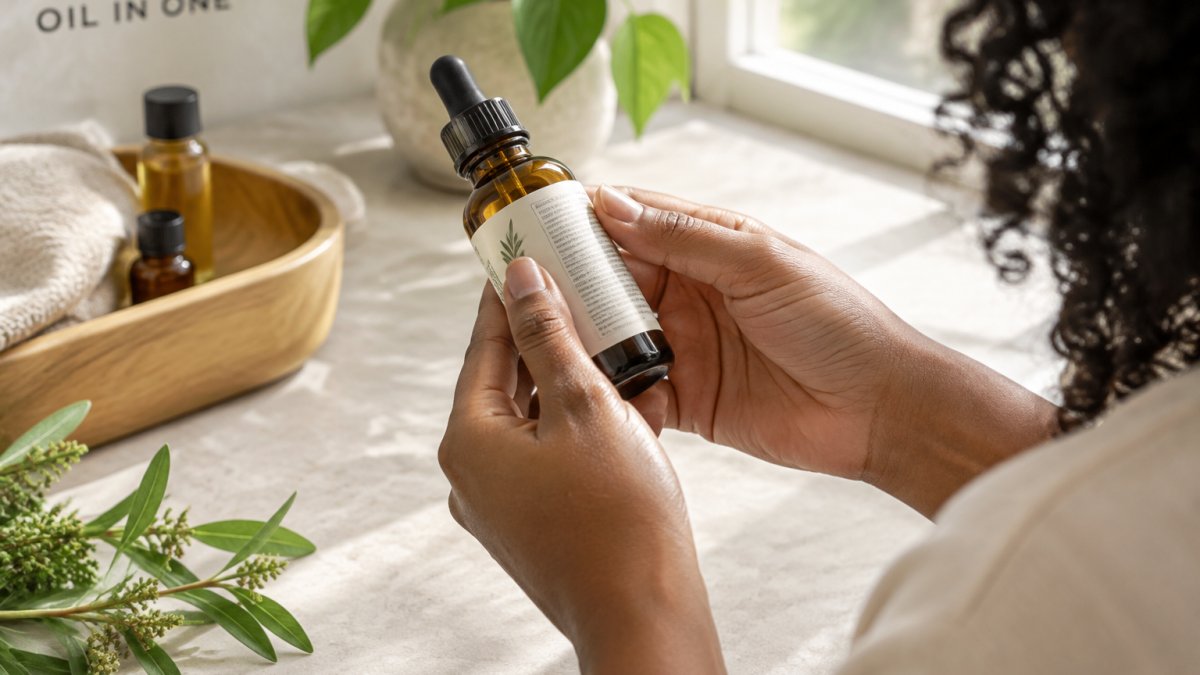
- Flip the bottle. Ignore the front panel entirely.
- Read the first five ingredients. That is the real formula.
- Translate the INCI names. Match each Latin name to its common plant.
- Check the hero plant's position. High on the list means real dose.
- Scan for fragrance, parabens, and sulfates. Note anything you react to.
- Look for tocopherol and an extraction method. Both signal stability.
- Confirm the product is registered. Check that the business is legitimate and that the product is registered with Dubai Municipality.
If a brand cannot answer step seven, that is your answer.
Choosing a Botanical Hair Oil You Can Actually Trust
Trust on a label comes down to three things: full disclosure, plain language, and a formula that matches what the front claims.
Our botanical scalp and hair oil with rosemary, bhringraj, black seed, and pumpkin seed combines 11 botanicals, is built from 100% organic raw oils, and is designed to wash out easily.
You now have the checklist. Use it on any bottle, including ours. Check the registration, read the first five ingredients, and if the back label holds up, you have found a keeper.
Reading labels is the easy part. Finding a formula that survives the read is harder. At Oil In One, we list every one of our 11 botanicals in plain language, build the blend on 100% organic raw oils, and keep it light enough to rinse out in one wash, so what you read on the back is exactly what reaches your scalp. Start with a single bottle, apply a few drops along each parting before washing three times a week, and give it a full 15 weeks before you judge the results.
Frequently Asked Questions
What does INCI mean on a hair oil label?
INCI stands for International Nomenclature of Cosmetic Ingredients. It is the standard naming system used on cosmetic labels worldwide, including in the UAE, so ingredient names appear the same across brands and languages. Botanical ingredients are listed by their Latin scientific names, such as Rosmarinus Officinalis for rosemary. Learning a handful of these INCI names for hair oil ingredients makes it much easier to compare two botanical hair oil products side by side without guessing what each term refers to.
How can I tell which oil is the main ingredient in a botanical hair oil?
Ingredients are listed in descending order of concentration, so the first few names carry the most weight. If jojoba or argan appears first, that oil forms the base of the blend. A botanical hair oil that lists its hero oil near the bottom is usually mostly filler. Check the first five ingredients and ask whether they match what the front label promises. If the front claims rosemary but rosemary sits tenth on the list, the marketing and the formulation do not agree.
What ingredients should I avoid if I have a sensitive scalp?
Scan for synthetic fragrance or parfum, sulfates, parabens, silicones, and high concentrations of essential oils, since these are common triggers for irritation. Patch test any new product on a small area behind the ear for 24 hours first. If a label hides behind vague terms like fragrance or perfume, treat that as a warning sign rather than a neutral one.
Are botanical extracts the same as essential oils?
No. Botanical extracts are made by soaking plant material in a carrier oil or solvent to draw out its compounds, and they are usually mild. Essential oils are highly concentrated volatile oils distilled from plants and are far stronger. In a botanical hair oil, carrier oils for hair and scalp form the bulk of the formula, while essential oils appear in small amounts for scent or specific action. A label that lists several essential oils near the top of the list may be too concentrated for daily use on a reactive scalp.
